Friday, January 30, 2015
The Beginner’s Guide to Podcasting

How Gail Goodman Optimized Constant Contact’s Funnel To Build the $1 Billion Email Marketing Empire
Thursday, January 29, 2015
A Marketing Process That Built Two 7-Figure Companies in Three Years
Become Intelligent: Use Google Analytics Intelligence Alerts to your Advantage
Posted by Martijn_Scheijbeler
Everybody remembers being in college, writing down activities in a logbook, hoping the hours they worked on a project were enough for a sufficient grade. After two years as an online marketer/SEO, I realized what makes writing down activities so important.
The intent of this post is to save you from making the same mistakes I made. If you're working for a brand, you probably want to make sure you're on top of all your KPIs, but few of us are able to carefully track our valued metrics 24 hours a day.
So in addition to providing you with some useful insights into why it’s so important to write down everything you do, I’ll also give you some useful tips on how to get this started with the tools you likely already use. Most importantly, I'll show you how to keep track of drastic changes in web traffic and user engagement.
How Meta Robots & XML Issues Impacted My Perception of Web Analytics
To give you an example of why it’s useful to keep track of what you and your team are working on, let me take you back to an incident I experienced roughly two years ago. My team tested an upgrade for functionally, but forgot to check the involved technical SEO elements. After a massive drop in keyword positions for all of our top (landing) pages, we did our best to retrace our steps. In the process, we discovered we had implemented the META robots noindex tag on all pages. I’d love to say I’m joking, but our drop in search traffic says otherwise.
I think you get the point—and that it’s probably best if I don't tell you about the time that we returned XML to Google instead of proper HTML—record everything. To this end, I’m going to share my insights into what I like to track on a daily and weekly basis via Google Intelligence Events, and share occurred events with our team, using the annotations of Google Analytics for our sites. I’m also hoping to hear your ideas on anything I'm missing so that we can learn from each other.
Rebecca Lehman made a great start back in 2011 with this, but in the past years a lot of new metrics and dimensions have been added to Google Analytics, making it easier to keep track of even more changes.
What are Google Intelligence Alerts?
Analytics monitors your website's traffic to detect significant statistical variations, and then automatically generates alerts, or Intelligence Events, when those variations occur. - Google Analytics Help Guides
Google Analytics provides you with predefined alerts that guide you through certain changes in engagement, traffic or visitor data, but they are hard to notice if you're not looking at your web analytics on an hourly basis. However, you are able to add custom intelligence alerts that update you of any changes that are important to you (e.g., when your traffic increases by 10% day over a single day). The tool makes it possible for you to respond faster to changing data, and you can also use it to keep your colleagues up to date.
Google Intelligence Alerts enable you to monitor your web analytics in many different ways, but they’re not without their disadvantages. Let’s look at both sides of the argument:
| Advantages | Disadvantages |
| You'll be notified within 24 hours. | You're not able to share intelligence alerts with your colleagues. |
| If you live in the US, you can get texts message alerts of important changes. | If you don't live in the US, you can't receive text messages. |
| You can keep track of almost every metric and dimension in Google Analytics. | Setting up a large number of alerts is a time-consuming process. |
| You can use your intelligence alerts in multiple properties as they belong to your personal Google Analytics account and data. |
|
Note: The email reports from Intelligence Alerts have a certain delay. Hopfully Google Analytics will improve this delay in the future, but for now it's the best we have to work with.
Why is This Useful for You?
I've provided you with just one example of how Intelligence Alerts can be useful. Now let me give you more insight into why it's easier for you to keep track of changes with Google Alerts. The average e-commerce store has thousands of products, each of which is likely to be impacted by seasonal preferences such as who's buying umbrellas in mid-summer. But what if it suddenly starts raining and your warehouse is running out of umbrellas? What if you could set up alerts to see if sudden product categories change in performance based on your data in Google Analytics?

Overview
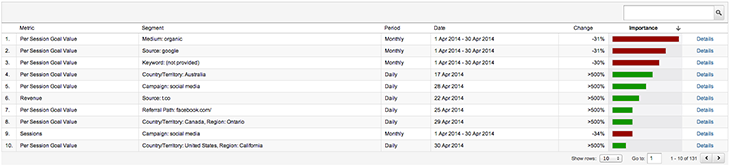
Image: personal screenshots
On the left side of your Google Analytics Reporting dashboard you have the ability to view the daily, weekly and monthly automatic alerts that Google has already triggered for you. This overview provides the most important metrics and dimensions for your site. For example, the screenshot below shows you the change in views throughout April 2014 for one of my accounts. Naturally, by clicking on details you are provided with more details on the period.
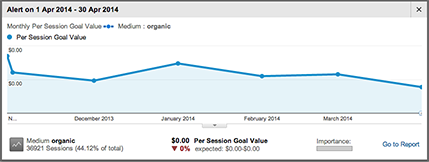
Image: personal screenshots
As you can see, the detailed view shows you the metrics again so that you can determine how importance each change is to you business. In this case, the graph tells you what the per-session goal value is, so you can see the weekly progress this metric made and why it triggered an automatic alert.
Daily, Weekly & Monthly Events
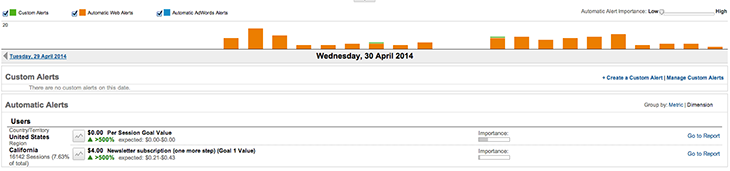
Image: personal screenshots

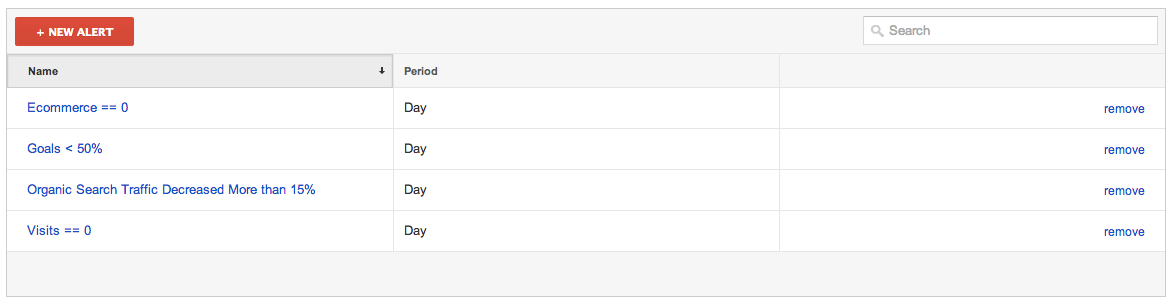
Image: personal screenshots
Overview: In the Admin of your Google Analytics View you're able to see an overview of current intelligence alerts. Click the New Alert button at the top.
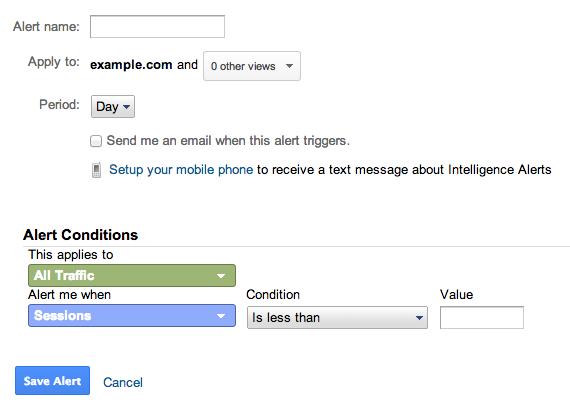
Image: personal screenshots
Now you have the opportunity to add a name to the alert and select the profiles you would like this intelligence event to apply to. By selecting the time period, you will be able to compare the current day, week or month to its previous variant. By setting the alert conditions, you have the opportunity to select the metrics and dimensions that must change in order to trigger a notification.

To save you some time, I've created a couple dozen intelligence alerts. The only things you need to do are log into your Google Analytics account and make sure you're ready to get overwhelmed with weekly or daily alerts. Seriously, though, don't feel compelled to add all of the alerts. Select only those that have the most value for you and your business.
Error/Panic
A couple of alerts could help you monitor the status of your site and the Google Analytics integration into the site itself. You'll likely want to know when certain tracking codes are removed and pages trigger errors:
- No traffic
- No goal completions
- No e-commerce conversions
- 404 Tracking (based on this great blog post)
- Revenue drop of XX% or no revenue
- Referrals from your own domain (this alert tells you that a tracking code is missing on certain pages)
Engagement
These alerts are ideal for publishers with lots of traffic:
Traffic Sources
If you suddenly have more traffic, but don't know where the traffic is coming from, the alerts for traffic sources could come in very handy:
- Increase / Decrease in direct traffic
- Increase / Decrease in organic traffic
- Increase / Decrease in paid traffic
- Increase / Decrease in referral traffic from a specific source
E-commerce
Monitoring the conversion rate for different browsers will make you aware of any problems your site has playing nice with certain browsers:
Google Adwords
If you're running Google Adwords, you undoubtedly have alerts set up. But it would be handy to know the performance onsite and to see the corresponding spend associated with it.if your spend goes up or down.

My favorite annotations are reports of bugs, new website features, and UX/ CRO improvements to popular pages.
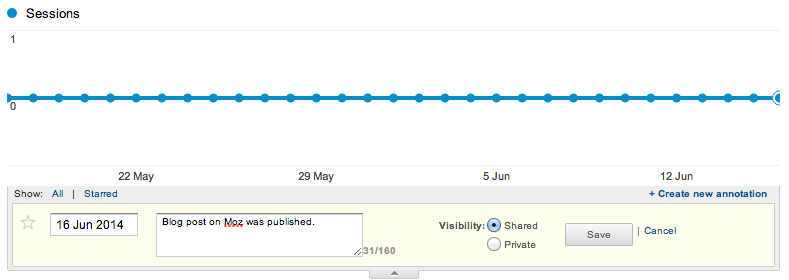
Image: personal screenshots
P.S. Dear Google Analytics product managers, if one of you is reading this, please make adding annotations available via the Google Analytics Management API. It would make it so much cooler if, for example, we could add a new annotation to our data for every new post in WordPress.
TLDR; Intelligence Alerts automatically keep you up to date on pre-configured changes in your data. With a daily email updates, you'll never miss important changes associated with your website's data, traffic or engagement.
Please let me know in the comments what your favorite intelligence alerts are and how you use them to your advantage. If you have any other tools that you use to keep yourself informed, don't hesitate to share them.
Sign up for The Moz Top 10, a semimonthly mailer updating you on the top ten hottest pieces of SEO news, tips, and rad links uncovered by the Moz team. Think of it as your exclusive digest of stuff you don't have time to hunt down but want to read!
Tuesday, January 27, 2015
How To Create Headlines That Get Clicks (Infographic)
Black Box vs. Tool Box Analytics in Digital Media
Monday, January 26, 2015
How To Install Marine Solar Panels
 Solar panels can be a great help to sailors, keeping vital lights and appliances functioning, even when batteries run low or a generator malfunctions. They are also a much quieter way of recharging batteries! Learning how to install marine solar panels will be vital for the sailor who wants their advantages, but first he or ...
How to Find out What Marketing Campaigns are the Best for Acquisition, ROI, & Retention
Sunday, January 25, 2015
Heating Your Home With Solar, But Without Panels
 With rising energy costs and massive stress on our electrical grids, solar is gaining in popularity. Not everyone realizes you can heat your home without buying big panel systems. Heating Your Home With Solar, But Without Panels – Gain You can use solar energy to heat your home through a concept known as gain. While ...
Saturday, January 24, 2015
Luxury Maids, Inc | Jupiter, FL Jupiter Exceptional Five Star Review by Jea ...
Get Great Tips About Solar Energy From Experts Who Know!
 Solar panel installation is a green solution. This is an investment that is important. You have to understand if it will fit into your budget. Continue reading to educate yourself about solar energy so that you can decide whether or not it’s the right choice for you. If you’re prepared to stick with the investment ...
Patrick McKenzie on Using Funnels and A/B Testing To Grow a Business
Luxury Maids, Inc | Jupiter, FL Jupiter Outstanding 5 Star Review by Jea H.
Friday, January 23, 2015
How Not to Commit This Awful Landing Page Error
What a Used Car Salesman Can Teach You About Empathy
4 Steps to Measuring What Matters Most
Thursday, January 22, 2015
6 Data-Driven Strategies to Get Your Content Published on Influential Sites
The Things I Look for in an Analyst
Wednesday, January 21, 2015
The Ultimate Guide to 150+ Google Analytics Resources for 2015
Tuesday, January 20, 2015
Seth Godin on Marketing in The Connection Economy
The Cellar Door Bistro | Ridgefield, CT Ridgefield Superb 5 Star Review by ...
Monday, January 19, 2015
Concentrating Solar Power Systems
 If you have ever seen a field with several mirrors pointing toward the sun you may be looking at a solar power system. These systems work to concentrate the sunlight to one area and use the heat to heat up the liquid that flows along the pipes. This system is called Parabolic-trough system. This type ...
Turning Clicks Into Conversions: 3 Tips to Recover Revenue
How ReadySetBoom.com Helped Us Close a $30,000 Solar System Contract!
How to Squeeze Every Drop of ROI from Your Lead Sources Using Salesforce
7 Ways to Get Traffic and Leads When Google Won't Send Them
Posted by Pratik.Dholakiya
You can’t count on Google.
No matter how great you are as an SEO, counting on Google to send you traffic is risky business. Also, feeling entitled to free traffic from a search engine monopoly is a bad business model.
I’ve always been a proponent of the idea that the best SEO strategy is the one that doesn’t count on Google. Such strategies aren’t only more profitable; they are also the most likely to last.
Unfortunately, it’s very easy to get SEO myopia. That’s why I’ve put together seven traffic strategies that don’t rely on Google at all. While most of them will help your SEO, either directly or indirectly, that’s not the point. On the contrary, a few of the strategies mentioned here are now looked down upon as SEO techniques that will get you penalized. But that’s only if you try to abuse them, rather than use them. Remember, we are not after rankings. We’re after traffic and leads.
Use these strategies to get traffic, with or without Google.
1. Influential Social Media Mentions
This is essentially what happens when somebody influential tweets a link to your blog post, somebody big embeds your image on Facebook, or a heavy hitter talks about you on LinkedIn.

Unbounce retweeted one of my tweets about a post on our blog.
The skills necessary to get an influencer to mention you prominently on a social network are very different from the skills necessary to work an online community, but I wouldn’t say they are better skills to have.
There are actually a couple different ways to go about doing this:
- Cold outreach – If you have a top-notch resource, usually something a bit more valuable than a blog post, cold outreach can actually still be effective. The key is to prospect and find influencers who will actually learn something, be surprised, and find your resource of value to them personally. Make sure you give them some context when you contact them, and be specific about why you think they would want to take a look at the resource. It’s also a good idea not to link to your resource in the first message. Instead, ask if they would like to see it.
- Relationship building – Building a relationship is different from getting involved in a community. And while it’s true that you’ll need to share mutual interests with those you hope to build a relationship with, it’s important to get to know them on a human level. Start things off by being giving (e.g., of information), and be sure to keep sending the occasional message, even when there’s nothing to gain. Remember, you’re trying to make an acquaintance. Build as many of these relationships as you can, then ask for their assistance when it makes sense.
While many modern marketers emphasize the second approach and downplay the first, I think this is a mistake. Influential relationships undoubtedly give you an edge, but if you have truly valuable resources, cold outreach will do a lot to increase your exposure.
At the same time, cold outreach is also a great way to kick off a relationship.
Note: This strategy is not limited to social media. It can be used to connect with any you feel could benefit from the information or services you provide.
2. Interviews
Influencers, such as podcasters, book authors, video bloggers, popular tweeters, and of course, bloggers, love interviews. Whether they’re in video, audio, or text format, they are a great alternative to guest posts; a good way to make your content more dynamic and conversational; and a powerful way to do something mutually beneficial without investing too much time or resources.
Afterwards, the influencer will often share the interview on their site, tweet it, post it to social networks, and link to it in their emails. Needless to say, this is a good source of referral traffic.
If you don’t think you have the clout to get an interview with someone especially influential, think again. Provided your website is professional and features content relevant to the audience of the person you'd like to interview, getting an interview with somebody noteworthy is a realistic possibility.

SEJ’s John Rampton interviews PPC expert David Szetela
You might think you need to have a lot of traffic on your site before interviews like these are possible, but this isn’t actually the case. You obviously don’t want to bring up how much traffic you have if it’s nothing to brag about, but this isn’t the only way to persuade an influencer to work with you.
For starters, it’s actually fine to pay an influencer to take part in an interview with you (or, for that matter, to write a guest post on your site). There is nothing unethical about compensating a busy influencer for the time they spend with you. We all know that it’s not kosher to open your wallet in an attempt to buy a link to your site. As long as you’re not literally paying the influencer to link to the interview, you’re not breaking any of Google’s rules.
(To be clear, it’s still a good idea to disclose that money changed hands. Even if you don’t consider the interview an endorsement, it’s better to err on the side of caution.)
I’d also like to say that it probably won’t cost as much money as you think to get fairly influential bloggers, authors, and online personalities to agree to an interview.
Of course, money isn’t the only way to persuade these people to agree to an interview, even if you don’t have a lot of traffic. Even if you do use money as enticement, it should mainly be used as an ice breaker. The more transactional the whole thing feels, the less exciting the interview will be.
Other things that play a part:
- If you don’t have any financial incentives to offer and you don’t have a lot of referral traffic to send their way, you can still entice them with the chance to have an interesting conversation.
- The more context you give to your outreach, the more likely you are to get a response.
- If you can point to previous interviews you’ve done with people they might know, they will often take you more seriously.
- If you haven’t done any previous interviews, you can still point them to a good resource on your site so that they can get an idea of who you are and what you’re good at.
Whether money gets involved or not, try to make this a relationship-building exercise. It’s easy to convince an acquaintance to have a talk with you for an hour or less for the purposes of creating an interview. It’s not so easy to convince a stranger to do it without at least trying to make them an acquaintance in the process.
And, of course, this swings both ways. Inviting an influencer to an interview on your site can be a good way to pick up traffic, but getting an interview on an influencer's site is also a great way to get referrals. I’ve noticed that most marketers don’t realize that both are beneficial, which is why I approached the subject from the perspective of asking an influencer to an interview on your site.
3. Resource Lists
Have you ever been to an educational site and noticed a resources page? Believe it or not, some of these lists of links are still heavily used and send a surprising number of referrals. While the spike in traffic from a resource list isn’t quite as high as what you might see from an authoritative blog post, they make up for it in longevity.
Actually, this is precisely what makes resource lists so incredibly valuable.
While a guest post on an authoritative blog or a mention from an influential tweeter can send a lot of upfront traffic, the effects aren’t necessarily cumulative. If you fail to turn any of those visitors into subscribers, for example, you are back to zero the very next day.
Resource lists are a cumulative traffic source. In that sense, they’re more like search engines than blog posts. Getting listed in a resource doesn’t bump up today’s traffic; it bumps up your repeated monthly new visitors.
Of course, you can’t simply add yourself to a resource list the way you can post on a forum or contribute to a social media community. Any worthwhile resource is going to be a curated list, with someone influential putting the resource together. You’ll need to understand outreach, and more importantly, have a standout resource, in order to get yourself added to a good list.
Similar approaches include:
- Creating a “Top 10” list of influencers in your corner of the market.
- Citing influencers as sources while you write your blog post.
- Creating a list of resources in your sector of the market that people can use to accomplish a goal or a series of goals. Many companies have set up their own online academy or learning center, where they share guides, case studies, and success stories. A shining example is Shopify, which provides legal, marketing, and SEO advice to online retailers by way of its e-commerce university.
Whatever the approach, the general goal is to create a valuable resource on your site that favorably references influencers within the content.
After publishing the post, you can contact the influencers included in the content and let them know you included them in the post. You don’t need to ask them to share the specific post, either. You can simply use it as a starting point to launch a conversation for collaboration down the road.
4. Affiliate Programs
Starting or joining an affiliate program can be one of the best ways to get referrals, provided you have a strong landing page with a high conversion rate.
Obviously, most SEOs thumb their nose at affiliate programs due to the obvious fact that affiliate links need to be no-followed in order to be legit from Google’s perspective. But we’re not talking about SEO here. We’re talking about referral traffic.
The nice thing about affiliate programs is that you don’t have to tip-toe around financial incentives and meticulously abide by Google’s terms of service. As long as you make sure the link is no-followed and abides by FTC guidelines, you’re free to pile on the incentives.
Affiliates have a clear incentive to send people to your site and convince them to buy: they get a portion of the revenue.

Image created by the author of this post
To convince people to sell your products, as opposed to somebody else’s, you’ll need to convince them that there’s more money in it for them. That means you’ll want a heavily tested, optimized landing page, and a product that the referrer can feel proud to endorse.
A good way to gain an edge is to contact bloggers and affiliate sites that are using Amazon affiliates or a similar program. Since these people have to share their profits with Amazon, their cut won’t be as big as it will be if they choose to sell your product instead.
At the same time, please realize that money doesn’t make outreach as mind-numbingly easy as a white-hat SEO might imagine. While you should obviously be clear about your intentions from the very beginning, there is still some relationship-building involved. Always give them context and personalize your emails as much as possible.
Using affiliates isn’t an excuse to spam people's inboxes. Approach this the wrong way and recipients will probably assume you’re involved in some kind of pyramid scheme.
5. iTunes
Like YouTube, podcasts are a good way to reach audiences who might have an interest in your subject matter, but who would probably never have taken the time to read your blog posts otherwise.
In addition to reaching people who are more engaged by audio than by text, you also get to take advantage of iTunes as a source of referral traffic. iTunes allows users to search podcasts by popularity and to see which podcasts are topping the charts. In other words, your traffic creates a positive feedback loop. The more listeners you have, the more new listeners you can reach. iTunes also makes it easy for users to share the podcasts with others.
Again, as with YouTube and SlideShare, iTunes is designed for discovery. Every time somebody listens to a podcast, iTunes shows them a “related” tab that can point them to similar podcasts. This allows new people to keep finding you long after a podcast is released.
A few pointers:
- Leverage your existing audience by asking your subscribers to subscribe to the podcast and by publishing the podcasts on your blog. Tom March explains how to embed a podcast here.
- Keep in mind that podcasts almost always work better as dialogues than monologues. It doesn’t have to be an interview exactly, but it should almost always be some kind of discussion. You could do what Fizzle does and primarily post discussions between founders or employees. You could make it interactive by doing Q&As with your audience. You could interview influential people like Derek Halpern does (which clearly will boost your exposure). You could even invite a friend to bounce ideas around with. But whatever it is you do, try to avoid taking on the format of a blog post. There’s something very unnatural about listening to only one person talk for an hour.
- To expand your reach still further, there’s nothing stopping you from posting your podcast on YouTube, even if there is no accompanying video. A static image of some kind is fine. In some cases, you will find that the number of subscribers and listens on YouTube is even higher than on iTunes, simply because it’s an easy-to-use platform that doesn’t require a download.
The truly great thing about iTunes, however, is the low barrier to entry as a subscriber. They don’t need to give you an email address, and they don’t need to fill out a form. If they already have iTunes, all they have to do is click a button on the screen. That’s it, they’re done.
Since iTunes subscribers are as valuable as email subscribers, this is a channel most marketers can’t afford to ignore.
6. Launch a Multi-Author Blog
If you’ve been in digital marketing for very long, you’ve probably heard of Social Media Examiner. The site picked up 124,000 email subscribers within 2 years and earned over $1 million in revenue before the first year was up.
What was founder Michael Stelzner’s secret to success? His secret weapon was the fact that he wasn’t an expert in social media. Don’t get me wrong, he had plenty of digital marketing experience. But the reason for the success of his blog was simple: He convinced a small army of influencers in the social media marketing camp to write just one blog post a month for the new site.
Needless to say, the results were dramatic.
How it all came together:
- He only asked the bloggers for a two-week exclusive. After that, the bloggers could post the same content on their own sites.
- They came to the agreement that by working together, their numbers would compound, which ended up being very true.
- He had existing relationships with all of the influencers.
- The site maintained exclusive quality guidelines and only published content from experts who had something new to say.
- They called it an online magazine instead of a blog, to be as unambiguous as possible about what they were trying to accomplish.
In short, the key to Social Media Examiner’s success is the fact that it launched with a pre-existing audience. The combined audience of the influencers who contributed to the magazine was more powerful than any of those audiences in isolation. It led to multiplier effects that made each individual blogger more successful than they could have been alone.
A multi-author blog that features contributions from influential people is like the extended version of quote hunting or a resource list. It leverages the existing audience of other influencers to grow your own influence, and it does so in a sustainable way.

Image created by the author of this post
7. Post a Poll
This one can be successful for a lot of the same reasons that quizzes are, but with a few tradeoffs.
- On the down side, polls are not necessarily as easy to talk about as quizzes. While they can certainly spur discussion, many users will feel like responding to the poll was enough feedback, and that they don’t need to share a comment to add to the discussion.
- On the plus side, however, polls can be more valuable to new users than quizzes. Consider Moz’s bi-yearly ranking factors study. While these now include correlative data directly from the search engines, they started out as a straightforward poll of expert opinion. While the correlative data makes these studies even more valuable, it was still an incredibly useful resource back when it was just a poll.
- Unfortunately, sharing a poll isn’t necessarily going to be a bonding experience in the way that sharing a quiz can be.
- On the plus side, polls can generate the kind of controversy that attracts attention and heated discussion.
- Polls can teach you about your audience, while quizzes won’t. A quiz can help you tap into which opinions are popular or unpopular among your target audience. This can help guide where you want to take your discussions in the future, and it can tell you whether you are attracting the kind of audience you desire.
You can use a free tool like Poll Code to embed polls right into your blog posts.
Choose One Now
One of the downsides of these list posts is they can be overwhelming. So I’d like you to do me a favor: bookmark this list for later. But, most important, go through this list right now and choose one of these strategies.
Just one. Commit to using it. Start a project, and finish it.
That’s all.
Sign up for The Moz Top 10, a semimonthly mailer updating you on the top ten hottest pieces of SEO news, tips, and rad links uncovered by the Moz team. Think of it as your exclusive digest of stuff you don't have time to hunt down but want to read!