Please visit Search Engine Land for the full article.
Monday, August 31, 2015
Mount McKinley Becomes Mt. Denali On Google Maps; Bing Stays With Old Name
Restored to its native name by US President Barack Obama, the transformation has yet to fully complete on the major search engines.
The post Mount McKinley Becomes Mt. Denali On Google Maps; Bing Stays With Old Name appeared first on Search Engine Land.
Please visit Search Engine Land for the full article.


Please visit Search Engine Land for the full article.

Sunday, August 30, 2015
Saying Goodbye to Click-Based Measurement
Using proxies such as clicks is no longer valid in this multi-device world. Facebook's Nadia Tan explains why it's time to say goodbye to click-based measurements.


Saturday, August 29, 2015
PV Solar Panel Glass
The glass in a solar panel is designed to protect solar cells, but at the same time as the light efficiently and reached the solar cells efficiently without thinking.
When we ask, “How does a solar panel”, tempered glass, which is the material used in the real panel must be part of our discussion. The reason is simple, is not easily broken and when it does not produce sharp pieces of glass that can cause harm to a person when it breaks. A tempered glass is as the glass material of the window of his car. Tempered glass panel also helps provide stiffness. If you have experienced the operation and development of a broken pane, you will feel it is unstable and can break if not completely handled some support from their fields, bottom and side. Now why use such a sign? Well, you need to carry the broken boards and send it to the manufacturer for warranty purposes, hence the need to ensure that no further damages.
Although solar cells have been integrated into the anti-reflective coating to prevent the inner layer of silicone to reflect light, the glass panel can further improve energy conversion using clear additional non-reflective material. But this anti-reflective coating on the glass may not last long or can not follow the life cycle of the panels and can reduce the performance of the panels in several years. Another method for resolving this problem is to texture the glass surface, which reduces reflection and even this to work, the rough texture may become a means of dirt or dust to attach to the surface and may not be easy or even winds heavy rains to evict them from the cup. This is where low iron tempered glass comes in where it provides long-term protection for panels of external harmful elements such as dust, water, chemicals, objects, or other biological factors that may impair the inside panels. This specialized type of glass is also stable under prolonged ultraviolet (UV), highly transparent, waterproof and gas and is self-cleaning. PV glass iron content is significantly reduced during manufacture to mainly improve transmittance.
Manufacture of glass for solar panels are not only to build it. Manufacturers also adhere to international standards in order to make safe and reliable glass.
Of course, if you build your own solar panel, you have the option of using special high quality glass however, if you are a beginner, a good glass material is Plexiglas, which has similar characteristics of tempered glass. Plexiglass is actually a brand name and also called safety glass. Knowing these facts about the glass used is only the first step in answering the question of “how a solar panel.”
Case Study: How a Brand New Site Attracted 6,618 Visitors in One Week
Posted by DI_Dave
We launched our brand new blog on Tuesday, July 7, 2015. The next day, we received about 200 unique visitors. By the weekend, we were receiving between 1,800 and 2,400 visitors per day.

It felt fantastic to see the blue line going up in Google Analytics. All those people flocking to a brand new website, signing up for our newsletter, and engaging in the comments. When I wasn't trying to keep up with all the interactions, I was skipping around the office with a stupid grin on my face.
So how did we do it? How did we turn a barren blog into a hotbed of traffic and activity?
In this case study, I'll show you exactly what we did and explain how it drove large volumes of traffic to our site. It you replicate what we did, there’s no reason why you can’t achieve similar success.
Step 1: Identify a problem to solve
We decided early on that we wanted to gear our blog to provide practical advice. You have a problem; we have the answer. To explain how we arrived at this decision, I need to tell you a little story.
A while ago, we took on new business as an SEO client. Let's call them Blueridge Cupcakes.
Blueridge had previously worked on their SEO with a different agency, which produced solid results. This SEO agency was content-forward, focused on creating long-term traffic sources through a highly targeted content strategy.
Blueridge, however, decided they wanted a change and opted not to renew their partnership. We pitched our services and won the contract.
Fast forward two weeks. We receive an email from our client. It's from Getty Images. Anyone who’s worked in content marketing knows what an email from Getty means: Someone’s used an image they weren’t supposed to. Sure enough, a blog posted nine months ago had used an image from Getty’s Rights Managed section. Yep, the expensive bit.
Just one image. Not even a particularly good image — a fairly unspectacular sunset someone had presumably found on Google Images and thought would fit perfectly in the blog.
Since we were now in charge of Blueridge's SEO campaign, we opted to pony up the cash.
While the payment was sufficient enough to elicit a high degree of pain, it gave us an opportunity to identify a problem.
People don’t use copyrighted material because they’re heartless, hateful creators. They use copyrighted images because they are easily accessible and they don't know where else to go.
Step 2: Research possible solutions
We had our problem. Now all we needed was the solution, which would come from hours of grueling research.
First, I persuaded our digital marketing manager to allow me to spent two full days looking for the best free stock photography sites out there.
Each site I found was measured against three criteria: quality, breadth, and freeness.
- Quality—Is the photography sharp? Are the images large enough to use in designs? Are the scenes composed well? Any site that couldn't answer these questions went in the bin.
- Breadth—This referred to the size and variety of each website’s collection, although I was quite flexible with this condition.
- Cost—First, I checked the license the site owner used to release images. Since the majority of our readers would be professionals, I filtered out all the licenses that prohibited commercial use. If images were released with an attribution licenses, that was fine.
Finally, before I added any sites to the list, I ran a reverse image search through Google on a random selection of images from the website. If I found them for sale elsewhere, I struck the website off the list.
Step 3: Write your blog post
With the list compiled, it was just a matter of getting everything written and designed. I included an image from each site to give readers an idea of each site’s particular style.
Additionally, I tried to inject some personality into each website's snippet to reflect the personality of the site. This kept the style fresh throughout, and also helped convey what sort of feel the images would have.
Step 4: Begin the community outreach
Once the blog post (i.e., article) was complete, it was time to begin the community outreach.
We had a huge list of outreach opportunities, covering everything from niche forums to Facebook groups. I worked through the list and selected the most appropriate opportunities for our article. We shared the blog with graphic designs, web designers, web developers, artists, freelancers, content marketers, and copywriters. We also shared it with our own social communities. We generated quite a nice buzz around the blog and got quite a bit of free promotion from readers re-sharing our content.
Two communities were by far the most receptive: Reddit’s /r/web_design and LinkedIn’s group for Graphic Designers and Art Directors. Here's a snapshot of our the social acquisition from a couple of the busier days.

Reddit and LinkedIn provided the lion’s share of traffic during the earlier days of our promotion, but were replaced by a more varied spread of sources as time rolled on. I really like starting with these platforms because they always reward genuinely valuable content. If you post something useful, the community will promote it to the top.
Step 5: Influencer outreach
With our list of communities exhausted, it was time to call in the favors. I fired up our CRM and cherry-picked influencers with a foot in design or content.
I sent them all a personalized email. My reply rate was roughly 30 percent, with the majority of respondents promoting the article through social media or their own blogs.
I also emailed all the stock photography websites we included on the list, asking them to help promote the article. Nearly all of them did.

Step 6: Keep promoting
If there's one secret to content marketing I can share with you, it's that promotion of your content never ends. While your biggest push should come in the days immediately after you’ve published, you should keep promoting your content to attract new readers.
Some additional techniques we use for ongoing promotion include:
- Email marketing
- Posting to news aggregators
- Monitoring social media for outreach opportunities
- Posting your link in the comments of related articles
- Updating your article and re-releasing it
Why you can do it, too
When we published our stock photography article, our blog was only one day old. We had no social following, and no connections tied to our new brand. However, what we did have was a good idea and determination. That’s all you need.
If you work smart and follow our framework, there's no reason you can't replicate our success with your own blog.
Sign up for The Moz Top 10, a semimonthly mailer updating you on the top ten hottest pieces of SEO news, tips, and rad links uncovered by the Moz team. Think of it as your exclusive digest of stuff you don't have time to hunt down but want to read!
A Drone Found A Man With No Chill Sunbathing On Top Of A 200 Foot Wind Turbine
It’s summer and the beaches are packed – so this guy got some private sunbathing time sky high
A drone pilot scoping out a giant wind turbine stumbled upon a man sunbathing on top of it.
Woken from his nap by the noise of the drone, he sits up, gives a wave, and looks rather nonplussed as the drone moves in further for a good look.
How Marketing Funnels Work
If you’ve spent any time learning about marketing analytics, you’ve probably come across the term “funnels.” If you’re curious about what they are and how they can help, this post is for you.
What Are Funnels?
You undoubtedly want visitors on your website to take certain actions. Maybe you want them to make a purchase, sign up, or fill out a form. When someone does something you want them to do, it’s known as a conversion. The visitor converts from browsing to taking the action you want them to take.
A funnel is the set of steps a visitor needs to go through before they can reach the conversion.
Think about the Amazon purchase funnel. There are a few steps a visitor has to go through before they can purchase a product. Here’s how it looks:
- They have to visit Amazon.com
- They have to view a product
- They have to add a product to the cart
- They have to purchase
There are additional steps/actions that can be taken in between each of these steps, but they do not matter in the purchase funnel. For example, a visitor may view Amazon’s About page, Contact page, and Careers page, but we don’t need to count these in the funnel because they aren’t necessary steps.
Why is the set of steps to conversion called a “funnel”? Because at the beginning of the process, there are a lot of people who take the first step. Then, as the people continue along and take the next steps, some of them drop out, and the size of the crowd thins or narrows. (And even further along in the process, your sales team gets involved to help close the deal.)

The top of the funnel is where everyone goes in (visiting your site). Only the most interested buyers will move further down your funnel.
So when you hear people say “widen the funnel,” you now know what they are referring to. They want to cast a larger net by advertising to new audiences, increasing their brand awareness, adding inbound marketing, etc. in order to drive more people to their site, thus widening their funnel. The more people there are in a funnel, the wider it is.
You aren’t limited to using your funnel strictly for signing up and/or purchasing. You can put funnels all over your website to see how visitors move through a specific website flow.
You may want to track newsletter signup (Viewing newsletter signup form > Submitting form > Confirming email) or a simple page conversion (Viewing a signup page > Submitting signup). Figure out what your goals are and what you want visitors to do on your site, and you can create a funnel for it.
Once you have the data, you’ll be able to see where roadblocks are and optimize your funnel. Let’s dig a little deeper into that.
Why Funnels Are Beneficial
With a funnel report, you can see where you are losing customers.
Let’s take your average SaaS business as an example. Here’s how a funnel may look for them:
- Visited site
- Signed up for a trial
- Used product
- Upgraded to paying
Do people have to use the product before paying? They don’t, but it’s a good idea to track it so you can see if it’s a roadblock for them.
Here’s how that funnel would look in the Kissmetrics Funnel Report:
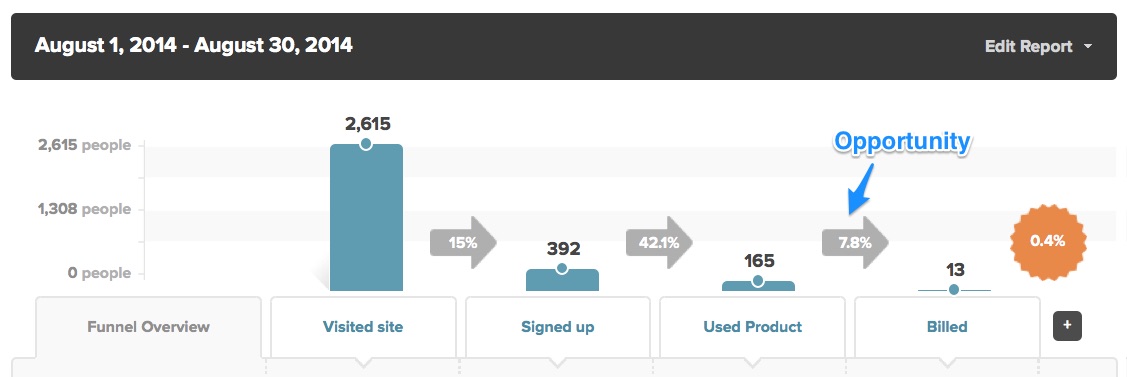
In this example, the business manages to get 165 people to use the product, but only 13 people convert to Billed. There are opportunities for improvement at every step of the funnel, but it’s important to first work on the areas that need the most attention. The more people they can convert to Billed, the more revenue they’ll have. This should be the first area of the funnel to optimize.
A Funnel in Real Life
Funnels occur everyday with consumers. Let’s look at the funnel process for a retail store and see the corresponding steps in an ecommerce store. We’ll be tracking a purchase funnel.

The Ecommerce store has the fortune of being able to see a funnel. If they use Kissmetrics, they’ll see the exact number of people that move through the funnel, and where and when they drop off in the purchase process.

Okay, so now we have an understanding of what a funnel is and why it helps. Let’s take a look at two products that offer funnels – Google Analytics and Kissmetrics.
How Google Analytics Funnels Work
Google Analytics offers funnels, and we’ve written extensively about it in the past. There are a few things you’ll need to know when creating funnels in Google Analytics:
- It’s a pretty basic funnel. If you don’t want to dive deep into the data and optimize, you can go with this.
- You cannot go back and retroactively view data. Once you create your funnel, you’ll only be able to the funnel going forward as the data comes in.
Click here to learn how to set up a conversion funnel in Google Analytics.
How Kissmetrics Funnels Work
Kissmetrics funnels, on the other hand, are simpler. You just create your events and then set up the report. Events are various actions people take on your website. These may include signing up, downloading something, clicking on something, viewing a page, using a feature, etc. Once you have these set up, you can create funnels. There are a few benefits to Kissmetrics funnels:
- You can go back and retroactively view data. Want to create a funnel that views your performance 3 months ago? No problem. As long as you were tracking data during that time, you can go back and view your performance. If you weren’t tracking data during that time, there are ways to import data into Kissmetrics.
- It doesn’t matter if people leave your funnel and then return to it and convert. In other words, they don’t have to follow a strict path. In the example funnel above, a visitor can go on other pages of your site before signing up. They don’t have to go to your homepage and then straight to signing up. If they go to your homepage, then your About page, your Contact page, and your Pricing page, and then enter signup, they’ll still be counted.
- It doesn’t matter if the conversion takes a long time to happen. As long as it’s within your date range, you can track it. Do you have people who visit your site one day and sign up 20 days later? If it’s within your date range, Kissmetrics will register the signup conversion.
- You can segment your traffic to see your most valuable segments. This can come in especially useful if you’re tracking traffic or UTM segments. Tracking these can help you find your highest converting sources. Once you know what they are, you can put more effort into getting more traffic from those sources. We covered this in this blog post on increasing conversions.
- We don’t track pageviews. Our technology tracks every person on your site. This means you can see each person in every step of your funnel. Take, for instance, the example funnel above. With the Kissmetrics funnel, you can see the people who did not convert to “Billed.” You can then email them to gather feedback and find out why they decided not to convert to paying. You can then take this information back into your product development and marketing.
Recap
We’ve gone through a fair amount, here’s a recap:
- When someone on your website does something you want them to do (i.e., sign up, make a purchase, fill out a form, etc.), it is known as a conversion.
- A funnel is used to track the steps that lead up to that conversion. For example, Ecommerce companies want people to purchase products on their website. Their funnel may have these steps – visited site > viewed product > placed product in cart > purchased.
- Using a funnel report you can see where people are dropping off in the path to conversion.
- Both Google Analytics and Kissmetrics provide funnels. Each have their unique use cases. Kissmetrics provides additional reports in addition to the Funnel Report.
Video Explanation
Want to know more about the Kissmetrics Funnel Report? Just click play below.
Ready to see how the Funnel Report and other Kissmetrics reports can be used to grow your business? Then request a personal demo today.
About the Author: Zach Bulygo (Twitter) is a Content Writer for Kissmetrics.
SearchCap: Google News Editors Pick App, Google Home Service Ads & Mobile App UI
Below is what happened in search today, as reported on Search Engine Land and from other places across the Web.
The post SearchCap: Google News Editors Pick App, Google Home Service Ads & Mobile App UI appeared first on Search Engine Land.
Please visit Search Engine Land for the full article.


Please visit Search Engine Land for the full article.
Stay Out of the Weeds: Plan Your Analytics Before Planting Your Code
When updating and optimizing analytics functions the final product is only as good as the preparation. These insights can help you execute an effective plan prior to code implementation.
Google Home Services Ads Launch In AdWords Express
Limited to the San Francisco Bay Area, the ads are available to a plumbers, locksmiths, house cleaners and handymen.
The post Google Home Services Ads Launch In AdWords Express appeared first on Search Engine Land.
Please visit Search Engine Land for the full article.


Please visit Search Engine Land for the full article.
How to Create Content That Drives Organic Traffic
When writing content, there are a lot of factors you have to keep in mind. You need:
- A great headline that’ll get people to click (without it being clickbait).
- Well-written content that must get to the point, move along, be an enjoyable read, etc.
- Memorable content.
- Content that achieves a goal promised early on. This article on book titles, for instance, implies that it will show you how to pick the perfect book title. So, by the end of the article, the reader should know how to do that, or at least have learned a lot.
- Content that creates engagement. If the article was written well, people will talk about it in the comments. This is especially true if they found something useful or had a question about something. (Hopefully, they won’t leave comments because they found errors or false statements in your content.)
- Content that gets some action out of the reader. This can be a social share, subscribing to your blog, commenting, following you on social, etc.
In addition to all this, the content should be search engine friendly. These documents from Google and Bing outline what they view as good content, but there are a few things they left out.
Today’s infographic shows you how to create content that drives organic traffic. Take a look….

Courtesy of: Quick Sprout
Content marketing is tough, but ensuring you have SEO down (see building an SEO optimized web page) will make your job a little easier.
For more on SEO and content, see our SEO category and our blogging category.
About the Author: Zach Bulygo (Twitter) is a Content Writer for Kissmetrics.
Making Your Support Content More SEO Friendly
Does your website have a support section, community forums, Q&A content, or similar? If so, columnist Tom Demers has tips for using this often valuable content to get more search visibility.
The post Making Your Support Content More SEO Friendly appeared first on Search Engine Land.
Please visit Search Engine Land for the full article.


Please visit Search Engine Land for the full article.
Subscribe to:
Posts (Atom)