Saturday, February 28, 2015
Six Crucial Attributes of a Successful Business Blog
Investing in owned media, such as a corporate blog, is crucial to a company's success in content marketing. But what does it take to launch and sustain a successful business blog? These six best-practices and tactics. Read the full article at MarketingProfs

The Benefits of Solar Energy
The use of solar energy or energy from sunlight has many advantages. Let’s take a closer look at each of them. • Solar energy saves money. In 2006, we saw the highest jump in residential electricity rates. In some regions, increased to 60% was observed. Many experts agree that the trend will continue in the ...
Friday, February 27, 2015
Recovering from Google Algorithmic Penalties: A Small Business Tells Its Story
Posted by SeattleCPA
Maybe the best place to start this story is April 2012.
At that point, my little collection of websites (a couple of topical niche sites, www.llcsexplained.com and www.scorporationsexplained.com) enjoyed about 800,000 unique visitors a year. To monetize that traffic—we did pretty nicely, thank you—we sold $40 e-books.
Late in April 2012, Google brought the hammer down on sites like ours. Overnight, organic traffic from Google dropped by, gosh, 90-95%.
Then things got worse. Google introduced new algorithmic filters that hurt our site or updated the same ones.

My principal “crime” was article marketing. As a writer by trade, I comfortably churned out dozens and dozens of articles and let article directories syndicate these babies to hundreds of low quality sites.
I need to put this out there, front and center: The articles used links with anchor text that was stuffed with keywords. In the end, the sites probably had 5,000 or so links each. Maybe 4,000 of each site's links were junky. They were bad links.
With the "algorithmic penalties", our e-book business seemed impossible to fix.
In fact, sometime during the summer of 2014, being ever-so-quick to open my mouth, I wrote a lengthy post in the Google Webmaster Tools forum that said the right way to think about all of this was to use the “Five Stages of Grief” model. What one wanted to do, I wrote, was to quickly get to the final stage of grief, which is acceptance.
Despite what I wrote in the forum, we ended up not taking our huge setbacks lying down. We proactively made the needed changes on our sites, and we worked hard to recover. By the fall of 2014, we did it. We recovered.

Now I am going to share the four steps we took that made recovery possible. Much of this information will look very familiar, and some of it will surprise you.
Step 1: Clean up the links
Obviously, we had to clean up the unnatural links pointing to our sites if, as we assumed, we were getting hit with Penguin, Panda and similar penalties.
Our first steps, therefore, were to delete all of the articles we’d posted at popular article sites. (In many cases this amounted to paying directories to remove articles.) This probably erased 1,000 to 2,000 links.
We also begged or paid other sites to edit the anchor text in the links they had pointing to our sites. In retrospect, this “fine-tuning” seems quaint and naive. But at the time, some people thought the unnatural anchor text was the problem.
When the first updates of the Penguin penalty didn’t reward us with any positive change, we then did pretty much everything else people say you should do.
I’m not going to list out everything we did, but if I could point to one important task we completed in this area, though, it is that the we either deleted or disavowed all of the junky links we’d accumulated (and which we continued to accumulate oddly enough).
Google, for the record, only sees the best and most natural thousand or so links to our sites.
Step 2: Create a new site
A quick point, and one I wish we’d implemented earlier: One of things we did (and should have done way sooner) was start from scratch with a new site.
Roughly 18 months ago, we started a blog, http://evergreensmallbusiness.com. That site now gets as much daily traffic as our topical niche sites used “pre-Penguin.”

You probably don’t need me to tell you that we have done no formal link building for this site. We try to acquire links naturally by promoting the site and its content.
Combining the effects of Step 1 and Step 2 (a digression)
A quick caveat: We actually never received all the traffic we used to get, pre-penalty. Let me share some rough numbers with you.
It would not be unusual for us, pre-penalty, to get 1,000 visitors a day to a site, with maybe 90% of this traffic coming from Google. That equates to 100 visitors a day from Bing or referring sites, and 900 visitors a day from Google.
After the penalties, that 900 visitors a day stream slowed by about 95%. Instead of getting 900 visitors from Google, the site enjoyed, say, 45 visitors on any given day.
And then things actually got worse. When we cleaned up the junky links, we also cut back on the traffic from other sources. (We actually used to get pretty good traffic from some of the article sites.)
Maybe the link pruning, then, cut the non-Google traffic in half to 50 visitors so that after all this, a site that used to get maybe 1,000 unique visitors a day (nearly 30,000 a month) squeaks along with just 95 visitors a day. Ouch.
Nevertheless, we saw a nice bump in Google traffic with the July 2014 and October 2014 updates. Across our heavily hit sites (those mentioned above), we saw maybe a five-fold jump in traffic. That sounded great. At first.
But when you do the math, given that you're coming off of a really low base value, you never get close to what you once enjoyed.
In other words, if Google is pouring say 40 or 50 visitors a day into a site and then quintuples this, you’re now looking at 200 to 250 visitors a day. Add to that the maybe 50 visitors coming from other sites, and you’re at 250 or 300 people a day—way less than we used to enjoy.
My point is that you can’t fully recover from a penalty or penalties simply through SEO auditing and general fiddle-faddling.
But, in one sense, you don’t actually care about recovering the traffic. You care about recovering the revenue. In that regard, a few basic fixes helped.
Step 3: Optimize conversion rates
The embarrassing thing about all that free traffic from Google was we didn’t really need to be very smart about optimizing our conversion rates or on-page usability.
Even if we did a crappy job in these areas, all we needed to do was compensate with more SEO-induced traffic.
Obviously, these days one can’t think that way. And so optimizing for conversion rates and improving on-page usability became part of the solution.
We’ve done all the standard things to our principal sites: adding excellent copy, making pages scannable, and tweaking the design of certain pages.
Though measuring the improvement gets tricky, we feel like we probably nearly doubled our conversion rate. (Honestly, we attribute improvement to the poor job we did with the pre-penalty websites. It was pretty easy to make big improvements to sites that were so inefficient and crudely constructed.)
Step 4: Improve the product mix
The final thing we did—and this thing was the cherry on the cake—was to get smarter about the products we sold and cross-sold.
Again, this is embarrassing to admit, but in our pre-penalty phase when we had all of that free traffic, we didn’t care if we only made one-time, relatively small dollar sales to a tiny percentage of our visitors. (Our do-it-yourself incorporation kits sold for about $40.)
Our mindset is totally different now.
We use the sites to sell CPA firm services. And because we serve a high-end niche, that means we’re really looking for individual taxpayers who become clients paying $1,000, or small business tax clients paying maybe $2,000 year. And the goal is for these clients to return year after year.
The product mix improvements, in the end, changed the game. In fact, we didn’t even need to recover from Google's algorithmic penalties once we fixed the product mix. However, improving our conversion rates and dramatically bumping up our web traffic certainly makes growing easier.
Sign up for The Moz Top 10, a semimonthly mailer updating you on the top ten hottest pieces of SEO news, tips, and rad links uncovered by the Moz team. Think of it as your exclusive digest of stuff you don't have time to hunt down but want to read!
How Customer Expectations Can Affect Your Conversion Rate
Richard Lee McNair was a convicted murderer. He’d just broken out of federal prison and was on the run. Police were everywhere, and he needed to get out of sight fast. He ran for a few hours, until he was stopped by Officer Carl Bordelon. For most prisoners, this is where the story would end, […]
Thursday, February 26, 2015
Solar Energy Systems for Pools
If you have a pool, you know how much warming can mount your electricity bill. Solar systems for swimming pools offer an alternative method that does not devastate your bank account. Solar energy systems for swimming pools When most people think of solar energy systems, they think of large crystalline structures that are intended to ...
Six Advantages of Hyperbolic Discounting…And What The Heck Is It Anyway?
I was tossing around concepts for an article, when I decided to settle on the issue of hyperbolic discounting. True to my collaborative self, I shared the title with an industry professional, and here’s what he emailed back: WTF is HyerpWTF&$*R.. Love it. So, these are the reasons I chose the subject of hyperbolic discounting: […]
Why Your Blog Is Not Adding Business Value, and What You Can Do About It
Although blogging is an effective marketing, branding, and sales channel, businesses don't make effective and efficient use of it. In fact, most corporate blogs add little real business value. Read the full article at MarketingProfs
How to Stop Spam Bots from Ruining Your Analytics Referral Data
Posted by jaredgardner
A few months back, my agency started seeing a referral traffic spike in our Google Analytics account. At first, I got excited. Someone is linking to us and people are clicking. Hooray!
Wrong! How very, very wrong. As I dug deeper, I saw that most of this referral traffic was sent from spammers, and mostly from one spammer named Vitaly Popov (or, as I like to call him, “the most recent pain in my ass”).
The domains he owns have been giving our company’s site and most of our clients’ sites a few hundred sessions per month, enough to throw off the analytics data in many cases.
His sites aren’t the only ones I’ll cover in this how-to, but his spam network has been the biggest nuisance lately. If you’re getting spam referrers in your analytics, you should be able to follow the same steps to stop these data-skewing nimcompoops from spoiling your data, too.
Why do I need to worry about blocking and filtering these sites?
There are two main reasons I’m motivated to block these on all sites that I work with. First: corrupt analytics data. A few hundred hits a month on a site like Moz.com isn’t going to move the needle when compared to the sheer volume of sessions they have daily. However, on a small site for a local plumber, 30 sessions per day is likely going to be 70% spam referral traffic, suffocating the remaining legitimate traffic and making marketing analysis a frustrating endeavor.
Second: server load and security. I didn’t ask them to crawl or visit my site. Their visits are using my server resources for something that I don’t want or need. An overloaded server means slower load times, which translate to higher bounce rates and lower rankings. On top of that, who knows what else they’re doing on my site while they’re there. They could easily be looking for WordPress, plugin and server vulnerabilities.
Popular referral spam domains
Using WHOIS.net, I found that Mr. Popov’s spam network includes these domains:
- darodar.com (and various subdomains)
- econom.co
- ilovevitaly.co (and other TLD variations)
Other spammers plaguing the web include:
- semalt.com (and various subdomains)
- buttons-for-website.com
- see-your-website-here.com
Many other sites have come and gone. These are just the sites that have been active lately.
Why are they hitting my site?
Why are people going through so much effort to crawl the web without blocking themselves from analytics? Spam! So much spam, it still blows me away. I looked into a few of the sites listed above. Three of the most prolific ones are doing it for very different reasons.
See-your-website-here.com

This site takes the cake for being the most frustrating. This site is using referrer spam as a form of lead generation. What is their product you ask? Web spam. You can pay see-your-website-here.com to perform web spam for your company as a form of lead generation. The owner of this domain was kind enough to make his WHOIS information public. His name is Ben Sykes and he’s from London.
Semalt.com

Semalt.com and I have had a tumultuous relationship at best. Semalt is an SEO product that’s designed to give on- and off-page analysis such as keyword usage and link metrics. Their products seem to be somewhat legit. However, their business practices are not. Semalt uses a bot to crawl the web and index webpage data, but they don’t disable analytics tracking like most respectable bots do. They have a form to remove your site from being crawled at http://semalt.com/project_crawler.php, which is ever so nice of them. Of course, I tried this months ago and they still crawled our site. I ended up talking with a representative from Semalt.com via Twitter after I wrote this article: How to Stop Semalt.com from Plaguing Your Google Analytics Data. I've documented our interactions and the outcome of that project in the article.
Darodar.com, econom.co, and ilovevitaly.com

This network appears to exist for the purpose of directing affiliate traffic to shopping sites such as AliExpress.com and eBay.com. I am guessing that the site won't pay out to the affiliate unless the traffic results in a purchase, which seems unlikely. The sub-domain shopping.ilovevitaly.com used to redirect to aliexpress.com directly, but now it goes to a landing page that links to a variety of online retailers.
How to stop spam bots
Block via .htaccess
The best way to block referrers from accessing your site at all is to block them in your .htaccess file in the root directory of your domain. You can copy and paste the following code into your .htaccess file, assuming you’re on an Apache server. I like this method better than just blocking the domain in analytics because it prevents spam bots from hitting your server altogether. If you want to get creative, you can redirect the traffic back to their site.
# Block Russian Referrer Spam
RewriteEngine on
RewriteCond %{HTTP_REFERER} ^http://.*ilovevitaly\.com/ [NC,OR]
RewriteCond %{HTTP_REFERER} ^http://.*ilovevitaly.\.ru/ [NC,OR]
RewriteCond %{HTTP_REFERER} ^http://.*ilovevitaly\.org/ [NC,OR]
RewriteCond %{HTTP_REFERER} ^http://.*ilovevitaly\.info/ [NC,OR]
RewriteCond %{HTTP_REFERER} ^http://.*iloveitaly\.ru/ [NC,OR]
RewriteCond %{HTTP_REFERER} ^http://.*econom\.co/ [NC,OR]
RewriteCond %{HTTP_REFERER} ^http://.*savetubevideo\.com/ [NC,OR]
RewriteCond %{HTTP_REFERER} ^http://.*kambasoft\.com/ [NC,OR]
RewriteCond %{HTTP_REFERER} ^http://.*buttons\-for\-website\.com/ [NC,OR]
RewriteCond %{HTTP_REFERER} ^http://.*semalt\.com/ [NC,OR]
RewriteCond %{HTTP_REFERER} ^http://.*darodar\.com/ [NC]
RewriteRule ^(.*)$ – [F,L]
Warning: .htaccess is a very powerful file that dictates how your server behaves. If you upload an .htaccess file with one character out of place, you will likely take down the whole site. Before you make any changes to the file, I would suggest making a backup. If you don't feel comfortable making these edits, see the WordPress plug-in option below.
Analytics filters
By itself, .htaccess won’t solve all of your problems. It will only protect you from future sessions, and it won’t affect the sessions that have already happened. I like to set up filters by country in analytics to remove the historical data, as well as to help filter out any other bots we might find from select countries in the future. Of course this wouldn’t be a good idea if you expect to get legitimate traffic from countries like Russia, Brazil, or Indonesia, but many U.S.-based companies can safely block these countries without losing potential customers. Follow the steps below to set up the filters.
First, click on the "Admin" tab at the top of the page. On the view column you will want to create a "new" view so that you still have an unadulterated report of all traffic in Google Analytics. I named my mine "Filter Bots." After you have your new view selected, click in to the "Filters" section then select the "+New Filter Button."

Setting up filters is pretty simple if you know what setting to use. I like to filter out all traffic from Russia, Brazil, and Indonesia. These are just the countries that have been giving us issues lately. You can add more filters as you need them.
The filter name is just an arbitrary label. I usually just type “block [insert country here].” Next, choose the filter type “custom.” Choose “country” from the “Filter Field” drop down. The “Filter Pattern Field” is where you actually define what countries you are filtering, so make sure you spell them correctly. You can double check your filters by using the “Verify This Filter” button. A graph will pop-up and show you how many sessions will be removed from the last seven days.

I would recommend selecting the “Bot Filtering” check box that is found in “View Settings” within the “Admin” tab. I haven’t seen a change in my data using this feature yet, but it doesn’t hurt to set it up since it’s really easy and maybe Google will decide to block some of these spammers.

Using WordPress? Don’t want to edit your .htaccess file?
I’ve used the plugin Wp-Ban before, and it makes it easy to block unwanted visitors. Wp-ban gives you the ability to ban users by IP, IP range, host name, user agent and referrer URL from visiting your WordPress blog all from within the WordPress admin panel. This a great option for people who don’t want to edit their .htaccess file or don’t feel comfortable doing so.
Conclusion
I hope this helps you block all the pesky spammers out there. There are definitely different ways you can solve this problem, and these are just the ones that have helped me protect analytics data. I’d love to hear how you have dealt with spam bots. Share your stories with me on Twitter or in the comments below.
Sign up for The Moz Top 10, a semimonthly mailer updating you on the top ten hottest pieces of SEO news, tips, and rad links uncovered by the Moz team. Think of it as your exclusive digest of stuff you don't have time to hunt down but want to read!
Tuesday, February 24, 2015
Do You Really Need More Facebook Likes? The Data Driven Answer
More Facebook likes! This is the driving passion of some social media marketers. They desire it. They dream about it. They crave it. They somehow think that more Facebook likes is the panacea for all of the world’s ills. But is it that important? Apart from my obvious hyperbole, are more Facebook likes truly going […]
Monday, February 23, 2015
5 Tips to Make Sure You Are Validating Early and Often
Whether you are a couple of coders in a garage or a small team in a large enterprise, validating your assumptions early and often can reduce the likelihood of failure, or at least get you to a pivot point sooner. The more chances you take, the more likely you are to hit a homerun. And, […]
3 Challenges in Multichannel Analytics
There are many solutions on the market for multichannel analytics, but most have their issues. Here is a look at some of the most common problems.


Saturday, February 21, 2015
Solar Energy Risks To Health
Solar energy is a potential free electricity and water heating source. It has the power to take advantage of electricity in remote areas of the world. It seems to offer health and safety with power, but is it? Rarely health risks of solar energy are mentioned. This may be partly due to the limited use ...
How to Get Your First $1 Million in Sales
Tyler Bosmeny is the co-founder and CEO of Clever, which is a fast growing company in the education space. He recently gave a talk at Sam Altman’s How to Start a Startup class at Stanford University describing how startups can get their first $1 million in sales. In the talk, he outlined the four steps […]
Corona Nissan Corona Terrific Five Star Review by raciel82
www.coronanissan.com 951-735-3360 Corona Nissan Corona reviews
Excellent Review
When we returned to California, after five years in Europe, the first thing we needed was an automobile. After going to multiple dealers, (and not feeling too well about our experiences), we ended up at Corona Nissan. Danny, was terrific – not the typical pushy sales person. He had the rare ability to listen to our needs and matched us with the right vehicle, a Nissan Titan truck, which we were able to buy with their low cost financing. We appreciated the professionalism of Corona Nissan’s staff and will come here first, for our next auto purchase.
Corona Nissan
2575 Wardlow Road
Corona CA
92882
Friday, February 20, 2015
Popup Showdown: 7 of the Best Popup Scripts and Plugins for Every Project
Back in the early days of the web, it was a scramble to find which business model would fly. Gone were the days of awkward sock puppets in Super Bowl ads or dancing hamsters taking center stage. The freshness and newness of the Internet was both exciting and worrisome. In those early days, Tripod.com was […]
Solar Energy Tips Everyone Needs To Know
Solar energy can seem quite complicated if you are not familiar with the technology and products used. You just need the right information so you can take the opportunity by the horns. Read this article to learn of the many benefits that solar energy can provide homes and businesses. You need to understand how you ...
Measurement Frameworks: Focus on the Metrics That Matter
There is certainly no shortage of data available to marketers, but the problem is often in knowing how to structure the data to get the most out of it.
Thursday, February 19, 2015
Why SEO Is Actually All About Content Marketing
There’s a bit of confusion over SEO and content marketing. The confusion comes over how SEO and content marketing fit together. Do they fit together? Are they at odds with each other? If so, is it possible to force them together? In a previous post, I explained why SEO and content marketing are like PB&J. […]
Wednesday, February 18, 2015
How To Use Vanity URLs and Avoid SEO Self-Cannibalization
Posted by MatthewEgan
Understanding URL structures is one of the few technical SEO flavors that every search professional must fully understand to be successful. Rand did an excellent Whiteboard Friday on the topic of Sub-domains vs. Sub-folders and 301s vs. rel=canonical tags (and it's a must watch), but many business owners like to leverage print and social media with their website and they prefer a sub-domain because it is easier to include in print or in a Facebook post.
Today I wanted to cover some fun and effective uses of Vanity URLs we've employed at Image Freedom that'll allow you to benefit from SEO best practices without sacrificing ease of access for your users.
What is a Vanity URL?

A vanity URL could be a completely unique URL totally removed from your main URL. It could also be a sub-domain that uses a 301 Redirect to point to a page deep within a sub-folder to make it easier for your users to get there. What separates a vanity URL from a micro-site URL or a sub-domain URL is that we never show Google that URL, it is purely for users to type in, such as in print banners or on a vehicle wrap, or for use on social media postings.
Using a Vanity URL for Multiple Keyword Sites
Let's say you own a company that deals with air conditioning, plumbing and electrical work. This is a complex group of keywords, so you want all the help you can get. Some wisdom might suggest that you create three websites--one that focuses on AC keywords, one that focuses on plumbing and one for electrical services. This wouldn't be an awful idea, but you'd be optimizing and building links for three unique domains and those domains would not share authority with each other. You would literally be tripling the work, too.
This is an excellent example of where Vanity URLs could give you extra options that still capitalize on SEO best practices. For example, say, our main company website is acme.com, but we might also register ACMAAir.com, ACMEPlumbing.com and ACMEElectric.com, one for each area of our business. Instead of building a website for each of these lines of services, we would choose our biggest line of business to be the primary keyword on the homepage (e.g., AC if you live in Texas as we do) and you would then place your plumbing keywords in http://www.acme.com/plumbing/ and your electrical keywords in http://www.acme.com/electrician/.
It is important that you don't self-cannibalize your keywords. So while I have assigned the AC keywords to the homepage, you then also don't want to create an AC landing page that repeats those keywords. If you must create a page that talks about AC (and in this case you do for the users sake), this is a great time to use the the rel=canonical tag on the AC page and point that topic back to the homepage. This way you are not fighting with your own sitemap for keyword prominence, which would hurt the chances for either page to rank. Self-cannibalization is one of the most common SEO mistakes we see in sitemaps. Fortunately, it's one of the easiest to fix.
To start out, our top-level sitemap would look something like this:

So now that we've laid out our top level sitemap, we can assess the use of Vanity URLs. We'll use an example using wraps, the all-over vinyl coatings applied to vehicles to highlight brands and their services.
Many companies use wraps on their vehicles and desire to include the URL in an easy to remember formatting. However, different lines of business often have their own vehicles or printed materials. This is where our Vanity URL comes in. To promote our plumbing pages and provide a great URL for use on our plumbers trucks, we could use ACMEPlumbing.com. Then, instead of building a whole unique site there, we simply 301 redirect that URL to http://www.acme.com/plumbing/. Google will then index your sub-folder for plumbing, but your users will be able to easily remember and type in your ACMEPlumbing.com vanity URL, satisfying both groups.
Our final top level sitemap would look something like this:

Google cannot read the text contained within an image. The crawlers can, however, read the file name and the alt attribute. But if you want to include keywords on a page where you otherwise shouldn't (such as placing plumbing keywords on your air conditioning-focused homepage) then using images is a great way to include language for the user, but then hide that language from Google. In the above example, I might include banners that talk about plumbing or electrical services but include that messaging solely within an image so it does not dilute my AC keyword placement. If you must include a contrary keyword (such as plumbing in this example) then make sure the keyword is a link to the appropriate landing page. In this case it would link through to http://www.acme.com/plumbing/.
Using a Vanity URL for a Franchise
In businesses with multiple locations, and those with franchises, it can be very tempting to segregate all of your different websites with unique URLs or on sub-domains. An excellent compromise here is to do both.
If I am selling cupcakes out of my ACMECupcakes.com franchise, I might want to register the ACMECupcakesSA.com domain name for San Antonio, but by placing my franchise offsite, not only am I starting from scratch with a brand new domain name (that will have no history or authority), I am also not able to share in the authority and history already created by the head office franchise at ACMECupcakes.com.
This is an issue I see quite a lot, and it winds up seriously hurting the franchise's SEO opportunities because the franchisee is not able to share in the authority and ranking potential of the franchiser. Thus the new franchisee has to start at zero and work their way up the rankings. By utilizing a vanity URL, I can point my ACMECupcakesSA.com URL to ACMECupcakes.com/SanAntonio and still have a nice short URL to place on my business cards

Each new city would have a sub-folder dedicated to that city, with appropriate keyword placement to rank in that city and appropriate internal linking so that the search engines know what the page is about. The business could them purchase a unique URL like ACMECupcakesAustin.com or ACMECupcakesDFW.com and have that URL seamlessly 301'd over to their sub-folder.
The fun thing about the 301 Redirect is that if anyone accidentally links to ACMECupcakesSA.com that link authority will be sent along through the 301 to the San Antonio sub-page. So even if you get links to either URL, Google still knows which to index and assign the authority to because of the 301.
Have Your Cake and Canonical It Too!
The key to any of the tactics listed above is the desire to control what Google indexes, and under what URL a given page is associated. The more indexed URLs you have, the more divided your authority becomes. Just as important, as you create new sub-pages, you don't want those sub-pages to be starting completely from scratch with no history and no authority to speak of. The idea is to work smarter so we don't have to work harder. The above techniques and tactics like them are just one way that you can have it both ways--capitalizing on the benefits of SEO while still leaving you all the tools to promote your sub-page as if it were a site all its own.
Summary Points
Sub-Domain: Google does not give a sub-domain equal authority as the domain it is under, thus in most cases the correct thing to use is a Sub-Folder. You can still 301 redirect a Sub-Domain to a Sub-Folder to use that Sub-Domain as a Vanity URL if you really really want to.
Sub-Folder: Sub-folders inherit the authority of the domain they are a part of, but you can still use a Vanity URL and a 301 redirect to give a direct URL path to the content on the sub-folder. The 301 redirect will send Google to the destination sub-folder path (which will be indexed), and the Vanity URL itself will not be indexed.
Vanity URL: A Vanity URL is a URL not meant to be indexed by Google, but instead might be included in print materials, on vehicle wraps, or as a link shared on social media. The Vanity URL is forwarded to a main site URL (often times a sub-folder) and only the destination is indexed by Google, the Vanity URL itself remains a useful (but passive to Google) tool.
Duplicate Content: With micro-websites it is important to remember that Google will lump websites together that have the same website content/copy. Thus it is important to write unique copy for each page that you want to rank, even if the content is very similar, it cannot be semantically identical otherwise it could hurt all micro-site’s chances of ranking.
Sign up for The Moz Top 10, a semimonthly mailer updating you on the top ten hottest pieces of SEO news, tips, and rad links uncovered by the Moz team. Think of it as your exclusive digest of stuff you don't have time to hunt down but want to read!
Survey Questions That Work: How to Unlock Your Customers’ Deepest Desires
How well do you know your customers and their needs? And, how well do you meet those needs? Do you just create a product and send it out? Or, do you take the trouble to analyze who your customers are, what they need, and how to best meet their needs? If you’re cool with just […]
Solar Energy Tips You Can Start Trying Today
Are you familiar with solar energy? Is there anything else you want to know about solar energy? If this is the case, you should learn everything you can and have a good plan for moving forward. Read on to discover how to take advantage of solar energy market. The number of solar panels to purchase, ...
Tuesday, February 17, 2015
Why Growth Hacking is a Team Sport
Reporting is part of every marketer’s job and—according to the experts—is an integral step in creating and maintaining a culture of growth. Yet most marketers don’t have a formal process or spend any significant amount of time compiling and sharing results with their teams. The findings of a recent study on GrowthHackers.com point to the […]
Sunday, February 15, 2015
Three New Twitter Updates You Need to Take Advantage of in 2015
Twitter recently announced new features set to roll out during the first half of 2015. Here's what they are and why you should care. Read the full article at MarketingProfs
Saturday, February 14, 2015
Would You Like To Create Video Content for KISSmetrics?
If you love our blog and would like to join our team as a videographer (video editor), then we would love to have a chat with you. Here are some details about the position: It’s a full-time, salaried position. Working remotely is an option. We’re looking for someone that is technically inclined. Knowing your way […]
The Perfect Pinterest Formula for Growing Your Following
Just a bit of know-how and practice can generate the kind of pins that engage other Pinterest users and drive traffic to your website. Millions of pins go up every day, but you can still make yours stand out. Read the full article at MarketingProfs
Friday, February 13, 2015
Three Easy Hacks That Bring the Power of Google Analytics and Salesforce to Your Online Marketing
What happens when you take two of the top online platforms in the industry and allow them to play together nicely? On our right, we have Salesforce. Salesforce proudly positions itself as the number one customer relationship management platform and does a stellar job of following the path a lead takes in becoming a customer […]
Thursday, February 12, 2015
9 Simple Tips For Making An About Us Page That Works For Your Brand
Posted by Ben.Austin
For too many online companies the About Us page is the elephant in the room, and often the most awkward thing to write. It’s a shame because analytics often shows the page as one of the most frequented on any website. Imagine a ceremonial elephant adorned in his embellished head plate, raising you above your competitors. This could be your About Us page if you show it the care and attention it deserves.
The good news is your about page doesn’t require several hundred pounds of vegetation on a daily basis, nor is there any real need for expensive antique rhinestones.
The bad news is crafting the perfect about page is easier said than done. Many find it difficult to strike the right balance between selling themselves to their customers and driving them away with a self-focused approach, which helps explain why the pages are so often neglected.
At Absolute, we’re looking to revamp our entire website over the coming months, and in particular we’ll be focusing our attention on our about page. We recognize that our page is currently a little on the dull side and while we are researching the topic, I thought it would be great to share nine great, easily applicable techniques we picked up from some of our favorite About Us pages from around the web.
Start by talking about your audience, not yourself
Human nature dictates that we are, first and foremost, concerned with our own problems. While some of us may give to charity or volunteer in our spare time, when it comes to searching for products or services online, we’re all about ourselves and what a brand can do for us.
Blog Tyrant is a great example of a blog that is focused on its visitors. The first thing you see when you land on their about page is a video titled “About Me and You." The text that follows is then split into two sections, “About Me” and “About You (The Tyrant Troops).”

Image Source: www.blogtyrant.com
If this frank, upfront style doesn’t suit your company there are more subtle ways to become more customer-orientated.
- Dedicate your opening sentence(s) to your audience’s challenges and objectives. Starting with the very reason they come to your site in the first place is a good way to demonstrate that you have their needs in mind. In our case, for example, it might be a good idea to acknowledge the difficulties marketing managers have in finding an agency that combines creativity with the essential technical skills, which can sometimes be overlooked.
- State the facts: If you’re still finding it hard to strike a happy medium between highlighting your selling points and plain boasting, then simply present your readers with the facts. This could be anything from your client retention rate to the amount of new products you offer each month to the number of awards you’ve collected. No one can argue with raw figures.
Let your customers do the talking
When you are thinking of trying out a new hairdresser, dentist or even a fish and chip shop, you don’t base your decision on what they say about themselves. You turn to those around you. By including a few glowing (and up-to-date) customer testimonials on your about page, you can create a hub of information.
- Be sure to include the customer or client’s full name and any relevant details that could add credibility to your testimonials. Better still, include photos of your customers, if possible. It all helps to build trust in your brand.
- Include customer-focused awards and accreditations. Perhaps you were voted your area's favorite provider of security products in 2013, or maybe you are part of some authoritative bodies or organisations within your industry. Exploit the instinctive human need to seek reassurance from our peers.
Include different forms of media
Make your about page a feast for the eyes by considering the use of photos, timelines, videos or infographics. If people are going to seek and find your about page, it makes sense to capture their attention for as long as possible, and this is precisely what Moz does. Their timeline incorporates strong image and design while still providing visitors with the key information they need.
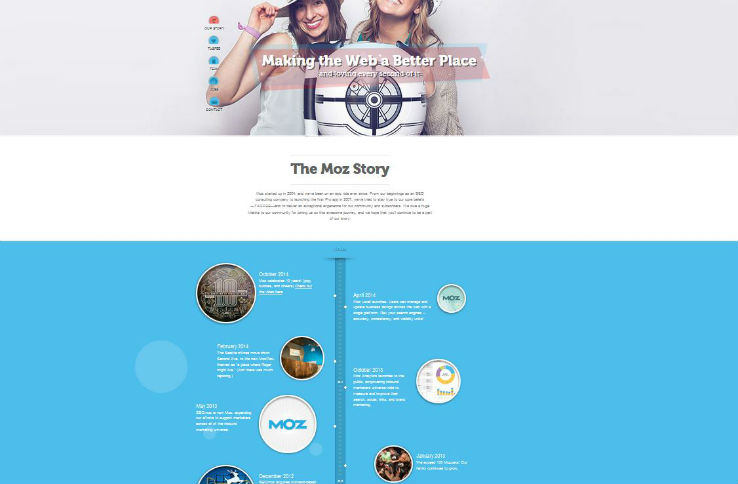
Image Source: www.moz.com
- Photos don’t necessarily need to be of each individual team member. Although individual head shots do help prospective customers visualize your company, head shots of management, photos of you in action at a fundraising event or even images from a work night out (preferably ones that aren’t likely to spark legal action), can all add character to your brand.
- Videos are a great way of entertaining those with particularly short attention spans and can sum up the feeling of your company in a matter of seconds or minutes. If you don’t have extensive time or resources in this area, Vine videos are a great way to add something different to your about page.
Tell your story
Even if your brand doesn't have an interesting story, you can still tell a story. Focus on the things that make you human.
That’s precisely what a client of ours, ITS, has done with their About Us page. Unfortunately it’s not something we can take credit for personally, but it still embodies everything a great story should have. It starts at the beginning, documenting their modest founding, in 1981 as a 150 square foot shop, all the way to modern day, with plenty of photos along the way. It’s great to see the quality of the photos changing through time, almost like a family scrapbook. Customer ratings and social icons make this page even stronger.

Image Source; www.its.co.uk
- Don’t be afraid of where you have come from. If, eight years ago, your headquarters happened to be your CEO’s conservatory, celebrate it. The more that people can identify with you the more trust they’ll place in your brand. We have become so desensitized to marketing that a company needs a personal touch to set it apart.
- You don’t have to tell people everything. If you have been established for 80 years, people don’t want to read a year-by-year account of everything that has happened in that time. Therefore, filter information accordingly, mentioning those key elements of human interest, but keep tales of new windows or a change of paper suppliers to yourself.
Include your address and contact details
Many people are still hesitant when it comes to parting with their money over the Internet and are thus keen to know you aren’t simply looking to fleece them to make a bit of extra cash.
- If you don’t want to disclose your full address, at least state your city or town. Potential customers are not so likely to get in touch if you’re less than forthcoming about your location. After all, what else might you be holding back?
- Make certain your contact details are up to date. It sounds obvious, but having an out-of-date telephone number or email address could not only lose you a sale but might also send alarm bells ringing.
- Your contact details should also include social handles and skype details if applicable.
Cut out the jargon
Writing in acronym-infested jargon might make you feel clever at the time, but it’s boring and it’s cold. People won’t remember you. What they really want when they land on your about page is to learn, in simple unambiguous terms, precisely what you do.
- Write conversationally. There is no best way to write. The style you adopt will depend on your company, but make an effort to write in a way that makes your content, and your site, feel accessible and friendly. The Adventurists site offers a great example of this. Their about page serve its intended purpose and is quite enjoyable to read. More to the point when they talk about “mobile phones tagged with twattery about which restaurant serves the best mocha-latte-frappeshite”, you find yourself agreeing with them, even if their greater aim of getting youto cross the sub-continent in a three wheeled lawnmower powered tin isn’t likely to happen anytime soon.
- Don’t name your about page some obscure name like, Our Ethos, or The Journey. People are looking for an About Us page, so give them one. Come up with a name that is too vague and people may miss you completely.
Ask for other peoples' opinions
Don’t be afraid to ask employees, friends, peers, even clients, what makes you stand out as a business. When you have worked somewhere for a long time, it is tough to see your brand the way customers might see it. An objective opinion can help.
- When you have decided on what makes you stand out, be sure to make this a focus.
- If your peer search becomes more like soul-searching because you find there is actually nothing different about your company, despair not. Don’t try and force something that isn’t there. Instead, turn it around and focus on what makes your audience unique.
Make sure it reflects your company
In our quest for the perfect about page, we came across some really extravagant examples. Some had really impressive videos, special features or high tech designs. All of those examples were extremely applaudable, but will only really work if this fits in with the rest of your website, your industry and your company as a whole. It's easy to lose sight of who you are in your mission to create the best page possible.
- Even if your website isn’t overly visual, you can still include photos, just make sure they follow the same format as the rest of your website. If your site focuses on boxy shapes and bold colors, then keep this theme running throughout your images. Just as with your marketing, the key is to be succinct. Maintaining a consistent look and feel automatically gives your brand more authority.
- The same goes applies for tone. Remember, in today’s multi-platform society, your website may not be someone’s first interaction with you, with visitors often reading an article or coming across a tweet beforehand. In that sense, an about page is almost like a meeting point, an amalgamation of everything that makes your brand who you are.
Test it!
There is no magic formula for about pages. If there were, you probably wouldn’t be 2,000 words into this blog. A good way to treat the process of creating such a page, then, is as a work in progress.
- Don’t be afraid to make amendments. Spend a fair amount of time checking your analytics for traffic volumes, bounce rate and visit duration on the page. Tweak the odd sentence, add images, chop them out, introduce a video, etc, based on what the data tells you.
- Make sure the page is accessible across all devices. It makes no sense to spend all this time creating an amazing page that is only visible to a small percentage of your audience, which is roughly what will happen if you ignore mobile and tablet users. Whether you have responsive design or a dedicated mobile site, test the performance of the page continually.
Of all the pages we looked at, our favorite is the one below, from Macmillan. Their About Us section is actually split into different pages, but the initial page makes use of video, explains briefly and simply what they do, includes contact details, testimonials and, most important, thanks people for their continued support.
Those readers who then want to learn more, as undoubtedly many will, can do so via links directing them to images of the team, as well as facts, figures and corporate partnership details. It might not be as flashy or as up to date as some, but it’s what best represents them and that’s the point.

Image Source: www.macmillan.org.uk
Sign up for The Moz Top 10, a semimonthly mailer updating you on the top ten hottest pieces of SEO news, tips, and rad links uncovered by the Moz team. Think of it as your exclusive digest of stuff you don't have time to hunt down but want to read!
How Adding Steps to Your PPC Landing Pages Can Improve Conversion Rates
If you’re anything like me, you know how important it is to improve your PPC conversion rates. You may already be a rock star in AdWords and a wizard on landing pages, but what happens when you run out of new testing ideas? Bids – Check! Negative keywords – Check! Landing page headline – Check! […]
Four Ways to Attract New Email Subscribers and Grow a Better List
You're on a constant quest to connect with prospects, customers, and subscribers. Cultivating a high-performing email list should be a priority. These four steps will help build your list--and boost your marketing. Read the full article at MarketingProfs
Good and Bad vs. Right and Wrong
Artificial intelligence is not just the stuff of science-fiction movies anymore, but what problems does it present for marketers?
Wednesday, February 11, 2015
6 Email Personalization Techniques That Go Beyond a Name
We are living in the era of personalization. We have an abundance of data at our fingertips, but we don’t always make the most of the opportunity it provides. Many businesses have been incredibly slow to take up personalization. In fact it has been reported that only 5% of companies personalize extensively. That is a […]
Let’s Get Personal for Valentine’s Day
This Valentine's Day it's all about drawing from the data available to boost personalization in your marketing. Are you ready?
7 Must-Have Salesforce Apps and Plugins to Grow Your Sales and Revenue
If you’re looking for ways to make sure your sales hit the ground running this year, you need more than just a great marketing team. You need maximum productivity, impressive reports and smart analytical analysis that doesn’t just drop a pile of data in your lap – but rather gives you the insights to take […]
Tuesday, February 10, 2015
How Dollar Shave Club Could Shave Costs & Grow Its Business With KISSmetrics
Dollar Shave Club is one of the frontrunners in the new subscription economy that seems to be getting more traction by the month. These businesses offer consumable products delivered to customers’ doors on a recurring subscription. Dollar Shave Club hit it big with their viral video that’s been viewed over 18 million times. After it […]
The 4 Horsemen of the Digital Analytics Apocalypse
Many things can go wrong in the world of digital analytics. Here are four common problems, personified as the four horsemen, and tips for how you can battle them.
Monday, February 9, 2015
Solar Energy Advice That Can Work For You
Solar power is becoming very popular. Anyone who owns a building can benefit from this energy source. If you aren’t sure how it works or what benefits await you, read on! In this article, we will discuss the latest and greatest in solar energy. Start small if you are just starting out with solar energy. ...
4 Things You Need to Know Before You Start Recurring Billing
Recurring billing is one of the hottest strategies in digital marketing, especially for SaaS providers. Right now, the trend is spreading faster than a Katy Perry song. Recurring billing — or we can call it the “subscription business model” — is the new black of Internet marketing. SaaS marketers know all about it, but you […]
The Meanings of Convergence
Convergence is becoming more prevalent in the marketing landscape, but it's hard to have a meaningful conversation about convergence unless we attempt to define it across different contexts.
Sunday, February 8, 2015
Do You Suck at Reporting?
Columnist Zac Martin gives his tips for better reporting on return on investment (ROI).
The 6 Tactics This SaaS Entrepreneur Used to Triple His Growth Rate
Brennan Dunn is a hacker and entrepreneur running Planscope.io. He recently gave a presentation at the 2014 Microconf discussing the 6 tactics he used to triple Planscope’s growth rate. This blog post provides a summary of each tactic. A real highlight of this presentation is that he doesn’t just discuss marketing. He discusses growth as […]
Saturday, February 7, 2015
How Hashtags Work on Twitter, Instagram, Google Plus, Pinterest, Facebook, Tumblr and Flickr
Posted by Ann Smarty
A hashtag is the wonder of the past decade. It was born to address the need to organize and make sense of the overwhelming social media buzz. Thanks to active and creative user adoption, hashtag support has been added to most popular social media platforms.
This article shows how different social media sites make use of hashtags. Most importantly, it shares some insight into how you can make the most effective use of hashtags for your brand.
Twitter hashtags don't support special characters like +, !, $, %, -, ^, &, *, etc. They do support letters, numbers and _ (underscore).
There are no hashtag limits (length, number) as long as you keep your message within 140 characters (which is already limiting in itself).
 While Twitter hashtags are reported to increase engagement, the most efficient way to use them is through hosting and participating in Twitter chats. Here's a detailed tutorial on hosting a Twitter chat.
Event hashtags (conferences, festivals, etc.) also work very well on Twitter. You don't need to actually be in an event to network with people through the official hashtag. Event organizers usually market the official hashtag very well, which means additional exposure for you if you use it.
Twitter search results are ranked by most popular. You can switch to "All" results, which are filtered by date.

Useful Twitter Hashtag Tools:
- Hashtagify tracks trending hashtags and shows "related" hashtags for any base terms you provide.
- TwChat lets you discover, participate in, and easily host Twitter chats. It's also a useful tool for monitoring and archiving any hashtag streams.
Like Twitter, Instagram hashtags don't support special characters like +, !, $, %, -, ^, &, *, etc. They do support numbers and _.
You can add up to 30 hashtags to a single photo. You can even tag your photo after publishing it. Simply list your hashtags in the comments. (Note that you can only do this for your own uploads.)
Instagram hashtags increase your following dramatically, especially if you use hot and trending hashtags.
The best use of hashtags on Instagram is to participate in hashtag games like #tbt and #MondayBlues. Both can make your Instagram posting very consistent (e.g., you have a theme for every day of the week) and increase your following and interactions.) In my experience, people are very willing to click these specific hashtags to see the photos of other participants.
Location-based hashtags also work very well for Instagram. I use both abbreviated and full location names (#la and #losangeles, for instance).
Instagram search results are sorted by "most recent".
Use Websta to track hot hashtags on Instagram.
Google Plus
The only official rule for Google Plus hashtag character support is "no spaces". However, you may have trouble using any characters (which are not letters, numbers or underscore) because Google Plus will attempt to drop them from the linked part of the hashtag.
There's no way to make a hashtag with numbers only (e.g., #2015).
Google Plus has perceived hashtags differently from the very start. Instead of letting users organize and monitor their conversations, Google Plus hashtags allow for greater exploration of the platform, by Google and users.
This explains why Google Plus updates are auto-hashtagged, meaning that they are added automatically by Google when the topic is clearly discerned.
There are no known limits to the number of hashtags you can add to Google Plus posts.
Google Plus hashtags seem to work great for exposing your updates to a wider range of people. I haven't found any research to back this up, but I've personally seen them work this way. Any time I use hashtags on Google Plus, I see more people outside of my extended circles like and comment on my content:

Unlike Twitter and Instagram, "specific" hashtags (e.g., games, events, and locations) don't seem to work well on Google Plus. Instead, I try to let Google understand what my update is about by using descriptive hashtags (e.g., #marketingtips).
Google Plus hashtag search results seem to be ranked by popularity. Moreover, search results are powered by "related" hashtags. Sometimes the result will even miss your initial search term.

Cyfe is the only tool I know of that supports searching and archiving Google Plus hashtag results.
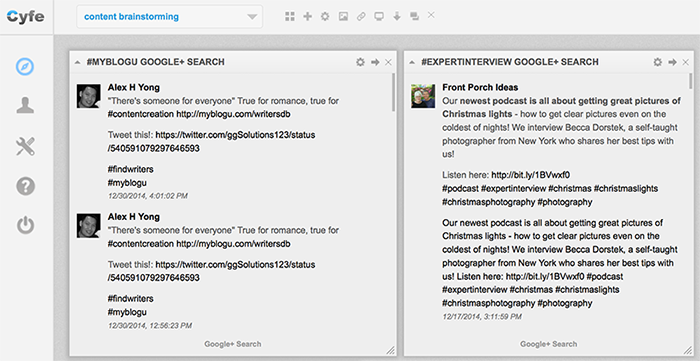
Pinterest hashtags have been quietly supported for some time. "Supported" means the word after the # is clickable (and only in the description).
There are no official rules or limitations on the number of hashtags you can add to a Pinterest post, and Pinterest hashtags seem to support the same set of characters as most other social platforms do.

Pinterest hashtag support remains limited. If you search Pinterest by a hashtag, search results will include all types of words and phrases from the hashtag. This makes using Pinterest hashtag almost pointless.

The only reasonable way to use Pinterest hashtags is to use them for branding, especially for cross-promotion (to further spread awareness of your event, Twitter chat, etc.).
Tumblr
Tumblr hashtags work similarly to Wordpress tags. They will be linked only in the "tags" field. You can't create an in-text hashtag by simply adding # in front of a word.
Unlike Wordpress, Tumblr hashtags improve the discoverability of your updates across the whole platform.
Here's a quick example: I am not really active on Tumblr, but I do post random updates from time to time.
I treat Tumblr more as a curation tool rather than a social media network, so I've never cared about hashtags or if my updates get any visibility, which they didn't until I used a few hashtags in this post. That day I saw a sudden spike in activity on my pretty abandoned Tumblr blog!

[Note: I did nothing special to create the spike. All I did was adding a few hashtags. Seems pretty easy, right?]
You can have spaces, apostrophes, commas, dots, and many other symbols in your Tumblr hashtags.

There are no limitations as to how many hashtags you can use on Tumblr, but only the first five hashtags you use are searchable. Your update will only make it to the search results if it's an original one, not a re-blog, so don't bother adding tags if you re-blog.
Any hashtag search will bring up users who recently used those hashtags for you to follow, which means that hashtags are huge for acquiring followers on Tumblr.

Tumblr filters hashtag search results by "most popular" by default. You can switch this to "most recent".
Furthermore, Tumblr has a “track your tags” feature which allows anyone to add hashtag search results to their "favorite search". There are no stats available as to which hashtags are tracked by more people, though.
Flickr
Flickr allows all sorts of symbols to be typed after the #, but seems to only link letters and numbers. While serving the same goal (e.g., organizing photos), Flickr tags and hashtags do behave slightly differently.
- Clicking on a Flickr tag brings you to search/?tags= page, where you can filter by license, search for groups, and more.
- Clicking on a Flickr hashtag brings you to /explore/ page, which shows related [hash]tags and the photos with the same tags (yes, that's confusing). These results are sorted by "most recent" by default, although you can switch to "most interesting."

It's still not quite clear whether hashtags improve visibility on Flickr, or how different they are from tags, which have existed on the platform for ages. The fact that Flickr hashtags were announced and are now proactively supported in the iOS app may indicate that the whole point of a hashtag on Flickr is to make it easier to organize your photos from the iPhone.
Facebook hashtags support the standard set of characters that most popular social platforms support.

There are no limitations as to the number of hashtags you can add to a Facebook update.
Facebook hashtag search is somewhat weird. Try searching for #california, for example. You'll likely end up landing on a Facebook page instead of a hashtag search results page.

An easier way to generate hashtag search results is to simply add the hashtag after facebook.com/hashtag/ (e.g., facebook.com/hashtag/dogs).
You can also bring up hashtag search results by clicking on any hashtag in your Facebook stream. Facebook's ranking algorithm is complicated. It seems to be a mix of lots of factors, including how closely you are related to the person posting the update, how often you interact with him/her, how popular the actual update is, etc.
I don't use hashtags on Facebook beyond random cross-posting from Instagram. I have also seen quite a few of my friends become irritated when someone uses hashtags, so I guess it's too early to tell. With Instagram's help, however, hashtags may ultimately become widely adopted by Facebook users.
To sum up...
| Google Plus | Tumblr | Flickr | |||||
|
Introduced |
August 23, 2007 | January 27, 2011 | September 25, 2013 | N/A | June 12, 2013 | August 18, 2009 | March 17, 2013 |
|
Supported characters |
Letters, numbers and _ | Letters, numbers and _ | Letters, numbers and _ ()no numbers-only hashtags | Letters, numbers and _ | Letters, numbers and _ | Any | Letters and numbers |
|
Limitations |
None | 30 hashtags per update, max | None | None | None | None | None |
|
|
Brand events and hold / participate in Twitter chats | Build a build following by participating in Instagram games |
Allow Google Plus to better understand what your update is about
|
[Don't work for discover-ability. May still be used for branding and cross-promotion] | [Don't really work for discover-ability. Getting used more often thanks to cross-posting from Instagram] | Organize your updates and build your following | Make it easier to organize your photos from mobile device |
|
Search results |
Are ranked by most popular (You can switch to "All" which are filtered by date) | Are sorted by "most recent" | Seem to be ranked by most popular (No way to change) | Are ranked by most popular | Are ranked by many factors, including relation and popularity | Are ranked by most popular by default (You can switch to most recent) | Are ranked by most recent by default (You can switch to most interesting) |
|
Best tools |
Hashtagify & TwChat | Websta | Cyfe | - | - | - | - |
(All images in this post were created by the author)
Sign up for The Moz Top 10, a semimonthly mailer updating you on the top ten hottest pieces of SEO news, tips, and rad links uncovered by the Moz team. Think of it as your exclusive digest of stuff you don't have time to hunt down but want to read!
Subscribe to:
Posts (Atom)