Please visit Search Engine Land for the full article.
Monday, November 30, 2015
Google Image Search Lets You Save Images For Later With Stars
Google brings back starring for saving image search results to your photo collections.
The post Google Image Search Lets You Save Images For Later With Stars appeared first on Search Engine Land.
Please visit Search Engine Land for the full article.


Please visit Search Engine Land for the full article.

4 Hot Mobile Marketing Trends to Watch in 2016
Few things have had such a profound effect on the way we live, work, play and socialize as mobile devices. From sending emails and texts to incorporating cameras, GPS navigation, menu ordering and entertainment, no one could have predicted that the humble “brick” would evolve to become such an integral part of our digital lifestyle.
But just as devices and technologies change, so too do our marketing methods. 2015 was the first year that mobile traffic exceeded that of desktop users. As marketers, this opens up a whole new field of ideas to try and avenues to pursue in order to reach these customers, create dialogues and forge relationships with them in a way that makes our offer irresistible.
Gone are the days of top-down communications, of intrusive ads and poorly aligned customer outreach campaigns. Today, we have more data than ever, and we’re leveraging it to come up with innovative trends and ideas like these:
Customer-Centric will become Customer-Obsessive

Big Data becomes Meaningful Data in our rush to learn more about our customers.
Image source: Connexia
It sounds like the makings of a horror stalker film, but the fact is, in our race to become more customer-centric, we, as marketers, are already bordering on obsession. We’re finally at the point where we’re not being swallowed up by wave after wave of big data, and can start using it to create more meaningful interactions.
Mobile is the vehicle that makes this happen. Few other things are as pivotal to sealing the deal as a device that the customer carries with them everywhere. Figuring out how to make that impact is something that companies are still working on, but you can bet it will be the customer, not the corporation, that powers how these decisions are made.
Search Engine Results Will Display More than Pages
You got Apps in my SERPs!
Google already displays videos in search results, but they’ve recently been experimenting with video ads as well. Other search engines, as well as other platforms like Facebook and Twitter, already leverage these types of ads in the form of auto-playing videos and Vines respectively – but at the moment Google is still testing the waters to determine how audiences respond to video-based ads.
Assuming users are receptive of the idea, don’t be surprised to see apps also sharing a place at the SERPs table. Sure, we already have app directories and recommendations, but apps as part of search results will take these directories and stores to a whole new level.
Also, don’t be surprised to see big shifts in mobile search. UI and UX specialists are still learning how we gesture, point, flick and tap on our devices, and with a search interface that’s designed for typing and scrolling, you can see how trying to wrangle a process built for computers into a small screen with taps and flicks just becomes an exercise in frustration. With so much data available, and so many past browsing habits to draw from, coming up with a page full of results is no longer going to cut it. It’s very likely we’ll see fully optimized, fine-tuned mobile search that enlists the help of third party apps to not just recommend a particular product, but find it in the customer’s preferred color, size, location, price range and much more.
Brands will Blur the Lines Between Apps, E-Commerce and Social
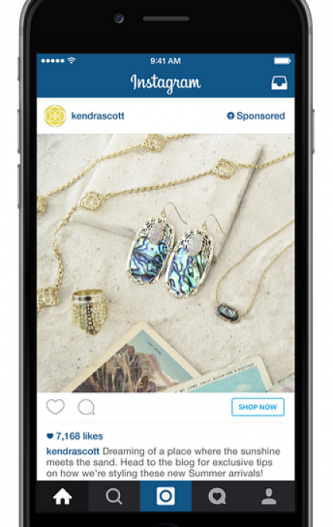
Well-known social platforms are taking their awkward first steps into becoming shopping centers.
Image Source: Adweek
2016 will be the year of even greater innovation from apps we already know and recognize. More seamless integration between those apps and their corresponding e-commerce and social outlets will become commonplace. Many social platforms are already tying e-commerce features into their networks. From Instagram’s “Shop Now” to Pinterest’s “Buyable Pins”, today’s hottest platforms are looking for ways to blur the lines between web, social, app and e-commerce.
As you might expect, the rallying cry from marketing has been “people don’t shop on social media!” but as mobile, social and e-commerce become more integrated, the possibilities open up to hit the right combination of buying and browsing buttons to turn that notion around.
Apps Become Reflections of our Lifestyles
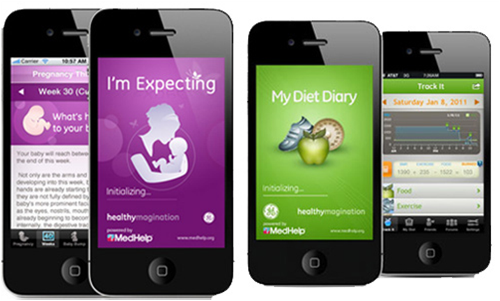
Apps will evolve to become more feature-full in an attempt to position themselves as a lifestyle choice rather than a novelty.
Image Source: EATT Magazine
The problem so far with consistent app adoption has been nailed down to one singular issue – bandwidth. With caps on data and insane overage charges, brands really can’t get as creative or forward-thinking as they might like to with restraints like those holding them back. These days, you might have one app for weather, one to track your fitness level and food input, and another to remind you when it’s time to pick up the kids from school.
Expect apps in 2016 to become less about individual features and more about becoming an integral part of your life – a fitness journal that displays the weather before your run and reminds you when it’s time to get the kids. Sound a bit far-fetched? Not to app developers. As long as there are forced restrictions on how much you can download, apps themselves play a pivotal role in position themselves as more of a lifestyle attachment than a usable “thing” that can quickly be uninstalled in favor of the next big thing. There’s only so much bandwidth that will fit in a mobile plan – better make sure your app is making the most of it.
What’s more, the apps you choose could very well communicate your values in terms of your lifestyle. Just like Doritos and the Superbowl or Mountain Dew and gamers, the apps you use every day could tell people “I’m proud to be a _______ and that’s why I use (app). The more attuned these apps become to our goals, likes and dislikes in life, the more they’ll find themselves being used likely far beyond what the original developers envisioned.
The Next Big Thing?
2016 is bursting at the seams with mobile potential, and that’s not even counting things like wearable technology and mobile automation systems like Echo, Cortana and Siri. At the end of the next year, we’ll take a look back and see how these trends played out. Did they catch on or fizzle out? Did something new and unexpected take hold of our collective attention? What do you think will be the next big thing? Share your ideas with us in the comments below!
About the Author: Sherice Jacob helps business owners improve website design and increase conversion rates through compelling copywriting, user-friendly design and smart analytics analysis. Learn more at iElectrify.com and download your free web copy tune-up and conversion checklist today!
What We Learned from Testing Content Freshness on 13 Blog Posts
Posted by karl62
We came across a case study on YouMoz with an interesting experiment to find out if traffic and rankings of blog posts could be increased by just changing their publishing dates. Specifically, the author tested to see...
- If you update a blog post's date, will it receive a boost in the search engine results pages (SERPs)?
- Can you fake freshness?
- Do you have to make changes to the content?
- If there is a boost present, how long does it last?
Our experiment: overview
We set up a test of our own test to see if the experiment could produce similar results. The site used in our experiment did not rely on traffic from blog posts; therefore, we didn't expect to see significant improvements, but still thought testing was worthwhile.
The details of our experiment
- The test was performed on a total of 13 blog posts.
- All the posts were originally posted between mid-2014 to mid-2015, but did not have consistent organic traffic. Some posts received zero views a full month prior to the experiment.
- The content was not edited.
- URLs for the posts did not change.
- The content topics were relevant to current search queries.
- Only the publishing date of each blog post was changed. On September 22, the dates were changed to either September 21 or September 22, so that the blog posts looked like they were no more than one day old.
- Posts were not shared on social media.
The plan
Before going ahead with the test, we took a look at the test posts to see how they were performing a full calendar month prior to the test.
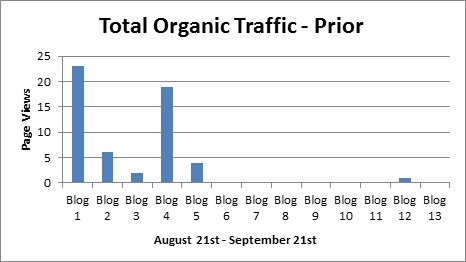
We wanted to include a mixture of blog posts in this test. As you can see, some blog posts weren’t receiving any organic traffic prior to the experiment.
The results
By comparing the data before (August 21 – September 21) to after (September 22 – October 22), you can see that on the majority of the posts, total organic views increased after the experiment was implemented. Blogs 1 and 4, however, did not improve. Blog 1 was originally posted on August 21, 2015, and was intentionally put in the experiment to prove that traffic does not improve if the blog is no more than one to two months old.
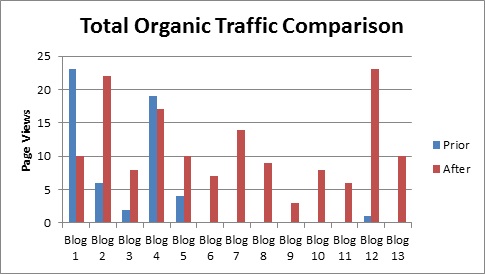
The experiment yielded an increase of 167.27% in organic traffic to the blogs, and increased unique page views by 226.92%.
Overall, general organic traffic improved. However, looking at data from Google Search Console, the blog posts did not improve in terms of clicks, impressions, nor keyword rankings. There was a slight improvement in average click-through rate, from 0.57% the month before the experiment to 1.40% for the month after. The reason for this result is likely that the chosen site did not rely on traffic from blog posts, which means they did not have large amounts of traffic before the experiment.
In the YouMoz post, the author states that their blog posts were already receiving consistent organic traffic and “If your post never ranked to begin with, changing the date isn't going to do much, if anything.”
Here is an example from Google Search Conole showing that the experiment had minimal influence on impressions:

Conclusion
For our experiment, changing the publication dates on the site’s blog posts did briefly increase organic traffic. However, results in the SERPs did not improve.
This test was meant primarily as a means to corroborate the study previously shared on YouMoz. Instead of seeing the improvements as having the makings of a long-term strategy, our team believes in the potential of using freshness to our advantage by updating the content with relevant information and images, then changing the publishing date to reflect the update.
In this way, you're not trying the game Google or see artificial results; you're making changes that could benefit your brand, the audience and, in some cases, your rankings in the SERPs.
Sign up for The Moz Top 10, a semimonthly mailer updating you on the top ten hottest pieces of SEO news, tips, and rad links uncovered by the Moz team. Think of it as your exclusive digest of stuff you don't have time to hunt down but want to read!
Sunday, November 29, 2015
Solar Power Systems Increase Community Resilience
Today, solar power systems provide a highly effective way for communities to improve their chances for being better able to function in the case of potential widespread emergencies.
Communities must adapt to the many changing conditions and threats that can occur in the event of an emergency or natural disaster. Solar energy and renewable resources are key components to increasing both community adaptability and resilience.
Reduce Reliance on Fossil Fuels
Eventually, hydrocarbon fuels will become scarce, causing prices to skyrocket. It is only a matter of time before the country faces another fuel crisis. By adopting solar power systems, communities can protect themselves against future price volatility in the fossil fuel market.
Using solar energy to supplement or replace power from the electrical grid can reduce a community’s reliance on the unpredictable costs and business practices of utility companies. It can also lower energy costs substantially, which helps reduce future economic uncertainty.
Photovoltaic technology provides energy security, as local solar development ensures a reliable source of power, no matter what fuel crisis may arise.
Be Prepared for Emergencies
When a tornado, earthquake, flood or other natural disaster or emergency situation occurs, communities must be able to respond quickly with appropriate recovery efforts.
Lighting and communications are essential in the event of an emergency, as is power for critical operations. Solar power systems can provide electricity wherever and whenever it is needed.
Highway message signs and advisory radios powered by the sun can be used to convey important information. Photovoltaic vehicle laminates and portable solar generators can prepare communities to handle the effects of emergency or disaster situations.
Create Power Resilient Critical Facilities
Storms and other extreme weather events can knock the power out for days at a time.
Although hospitals and other critical facilities may have generators, the rest of the community can be left without energy. In addition, traditional generator power depends on the availability of fuel. Once the fuel supplies are gone, so is the electricity, leaving emergency shelters and mass care points without reliable sources of power.
Communities can use solar power to create critical facilities capable of meeting the public’s needs during and after an emergency situation. Medical centers and fire and police stations must be adaptable, functional and able to provide services throughout any crisis event.
Installing solar energy systems at these locations and at designated shelter areas will help ensure that emergency services are always able to respond to any disruptive event in the community.
Adopting solar power to address a growing community’s developing needs is of particular importance in lower-income areas, according to many experts. As PV power is renewable and cost-effective, solar energy can be used to bridge the gap between the poor and the well-off, helping to relieve more vulnerable populations from added suffering from the damaging aftereffects of a natural disaster or emergency situation.
Every community must address the matter of resilience now, to be adequately prepared for the future. Contact an experienced alternative energy expert in your area to learn more about how solar power systems can help to meet the changing needs of your community.
Friday, November 27, 2015
Why Everyone Should Be Moving To HTTP/2
A Google spokesperson recently revealed that GoogleBot will soon support HTTP/2. Columnist Patrick Stox explains what this is and what it means for SEOs.
The post Why Everyone Should Be Moving To HTTP/2 appeared first on Search Engine Land.
Please visit Search Engine Land for the full article.


Please visit Search Engine Land for the full article.
Thursday, November 26, 2015
Thanksgiving Google Doodle Features “Three Sisters” Of North American Crops: Corn, Beans & Squash
Google shared initial sketches of today's Thanksgiving Day logo created by guest Doodler Julia Cone.
The post Thanksgiving Google Doodle Features “Three Sisters” Of North American Crops: Corn, Beans & Squash appeared first on Search Engine Land.
Please visit Search Engine Land for the full article.


Please visit Search Engine Land for the full article.
Wednesday, November 25, 2015
SearchCap: Google Store Data, AdWords Shopping Ads & Semantic Search
Below is what happened in search today, as reported on Search Engine Land and from other places across the web.
The post SearchCap: Google Store Data, AdWords Shopping Ads & Semantic Search appeared first on Search Engine Land.
Please visit Search Engine Land for the full article.


Please visit Search Engine Land for the full article.
The Complete Guide to Website Push Notifications for Ecommerce
Website push notifications are clickable messages that are sent by a website to their subscribers’ browsers. They work very similarly to mobile app push notifications (notifications sent by a mobile app that land in your notification tray) except that they work on websites instead of apps and can be accessed on all devices (desktop, mobile, tablet, etc).
In this article, we’re going to take a look at website push notifications in the Ecommerce space. We’re going to discuss why Ecommerce players cannot afford to ignore website push notifications, how they work and how to optimize your push notification campaigns to deliver great results for your online store. Let’s start!
Why use Website Push Notifications
A brief look at the communication channels for Ecommerce
Ecommerce businesses use a variety of ways to grow their traffic i.e. new visitors, as well as engage with their existing traffic i.e. the folks who have already visited your website. These include exploring various communication channels – email, social media, SMS, push notifications (both websites and apps); it also involves employing these channels in different kinds of campaigns to reach and engage users. Let us take a brief look at each of these channels and try to understand where they prove useful.
Email is most commonly used to deliver curated product suggestions, advertise upcoming sales and discount offers, ask for product reviews, recover abandoned carts, deliver transactional information such as order confirmation, tracking details etc.
The main advantage of email marketing is that it has a wide reach – a study by The Radicati Group reveals that there are currently 2.6 billion email users, which means that more than 1 out of 3 people have an email account. Another very important advantage is that an email stays in the inbox, accessible anytime, unlike social media messages and notifications, which are harder to access later (or even impossible). This is particularly useful for delivering important information like order and tracking details.
Where email marketing misses out, however, is the ability to deliver time-sensitive information. According to Zipstripe, the average time for email recipients to view an email message is 6.4 hours. This means that email is not effective for sending time-bound emails, such as coupons with a tight redemption period, or important actionable information such as “Your package is out for delivery”.
Social Media
Social media networks (Facebook, Twitter, Pinterest, Instagram) work better than email marketing when it comes to delivering short-time offers and discounts since people spend more time on social media websites than on any other online activity. So, what’s the problem? It’s the problem of engagement – only 0.07% of your Facebook audience interacts with your posts and the figure is 0.03% for Twitter. What this means is that social media is not very effective for messages designed to achieve a specific purpose in a specific time, since so few of your audience will actually react to that message. Instead, social media is better employed as a means to establish your brand and build a relationship with your audience.
SMS
SMS is effective if you want your user to read your message very quickly – 90% of SMS messages are read within the first 3 minutes. This makes it useful for communicating important business-information like “Your cab is arriving” or “Your item will be delivered today”.
SMS should not be used for information that the user will need to access later, such as receipts. SMS messages are difficult to search later on. Another disadvantage of SMS messages is that they can only contain a maximum of 160 characters, which drastically limits the kind of communications you can have through SMS.
Push Notifications (Mobile apps)
Push notifications is the default way by which mobile apps communicate. It scores over email for promotional content in that it delivers messages in real-time and it has also reported higher response rates compared to email (Open rates for push notifications are 50 percent higher than for email, and click rates are up to twice as high, according to this survey).
It is tempting to think of app push notifications and SMS as the same but they have crucial differences – the opt-in/opt-out options in app push notifications give the user greater control over what kind of messages he/she wants to receive. SMS on the other hand, often comes unsolicited and it is harder for the user to disable. Because of this, SMS is often perceived to be a lower messaging medium.
Where does Website Push Notifications fit into the picture
Website push notifications fit into a very unique spot in this entire spectrum. It differs from mobile app push notifications in that while app push notifications are limited to mobile devices and tablets, website push notifications also covers desktops. Desktop usage still accounts for 42% of total internet time. Web push notifications deliver the power of real-time push notifications to this 42% of internet users.
Another point which makes website push notifications very important for Ecommerce is the cost factor. Building a quality app is an expensive affair and sometimes the ROI can be difficult to justify. In fact, for small and medium sized companies, mobile websites may reach more people than mobile apps do. This makes website push notifications more critical since it gives businesses the ability to send push notifications without investing in an app.
All in all, it can be seen that website push notifications is an important channel for Ecommerce since it gives websites the power of instant communication via websites and that too on all devices, be it desktop mobile or tablet.
How do Website Push Notifications work
By default, whenever you install a mobile app, you give the app the permission to send you push notifications on your device. Websites, however, have to explicitly take permission from their users to send them push messages. This is how website push notifications work:
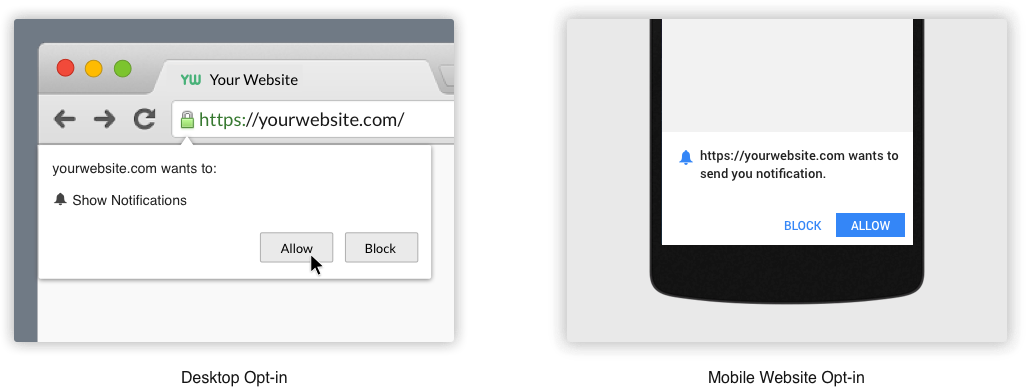
- The first step is getting opt-in from visitors. As soon as someone arrives on a website, an opt-in box is triggered. If the visitor clicks on “Allow”, he/she is added to your subscriber list.
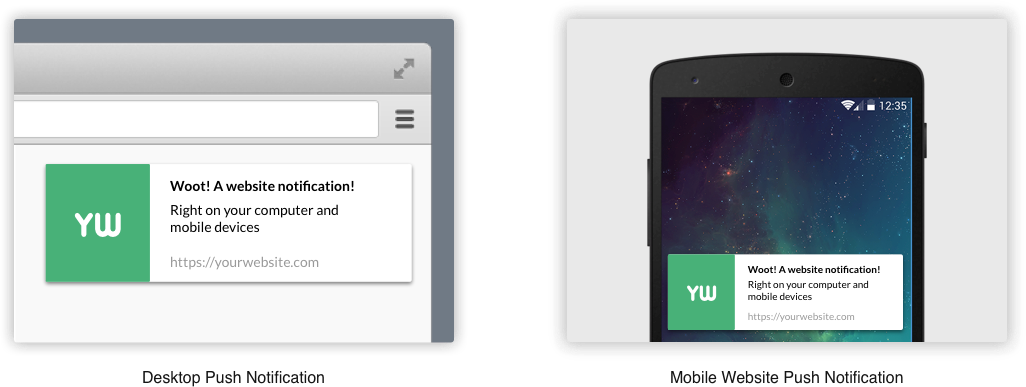
- As soon as a ‘visitor’ becomes a ‘subscriber’, you can send them push notifications from your website. The title message and the text message are customizable within certain character limits and a URL has to be specified. These notifications will arrive in real-time even if the browser is not open at that point of time. Clicking on the notification will take the subscriber to the URL specified.
Optimizing Push Notifications
Now that we’ve established the importance of push notifications and how they work, it’s time to take a look into how to optimize your push notifications to drive more sales from your existing subscribers. This section is divided into the following subsections – writing great push notification copy, when to send a push notification, how frequently should you send push notifications, using segmentation to send personalized notifications and, lastly, what metrics to track.
Copywriting for Push Notifications
Since push notifications impose character limits on the title as well as the message, the copywriting becomes that much more important since you have to squeeze your message into a small package while still retaining its effectiveness.
Whenever you are writing the title and message text for a push notification, the most important thing to keep in mind is that the purpose of the copy is to get subscribers to click. For that, your copy needs to, above all, provide some value to the subscriber. People will only click on the notification if they find it valuable.
Here are a few tips you can follow:
- Be clear in what you are saying – Your subscribers have busy schedules and do not have time for vague messages. Do not test their patience by making them think. A clear message will have a greater click rate by the very virtue of the fact that it is action-oriented. In a fight between “Have you read Jeffrey Archer’s latest?” and “Jeffrey Archer’s latest novel available for purchase”, I’ll always go for the latter because it is clearer in its message as opposed to the former.
- Be crisp in your copy – Different platforms have different character limits for push notifications but all of them fall in the range of 40-120 characters. Thus, it is very important for you to be very concise in what you are saying. This often means that you need to identify the one most important value proposition of your message and let that shine through in the notification copy.
- Use scarcity to create urgency – According to Dr. Robert Cialdini, author of Influence: The Psychology of Persuasion, we are more motivated by the idea of potential loss than of potential gain. That is, if we find that an opportunity is closing, we want it that much more. This is also known as FOMO (Fear Of Missing Out).
You can use this psychological principle when you write your push notification copy. For example, if you have a sale coming up for your online store, try sending a push notification that says something like, “Flash Sale! 12 hours only”. - Use Social Proof – IBM’s marketing slogan in the 80s, “No one ever got fired for buying IBM”, is one of the most powerful marketing phrase ever created. This is one of the most powerful examples of social proof, where the company used the tendency of people to go along the established route.
In push notifications, social proof can be used to increase click rate. For example, you can write something like, “4000 marketers have already registered for this event” if you want people to register for an event or “This post has more than 1000 Twitter shares” if you want subscribers to click through to a blog post.
Keep in mind, though, that this is not the 80s and internet users have access to all the information they need on their fingertips. Thus, it is important to not go overboard with claims and only write stuff that is credible.
When to send Push Notifications
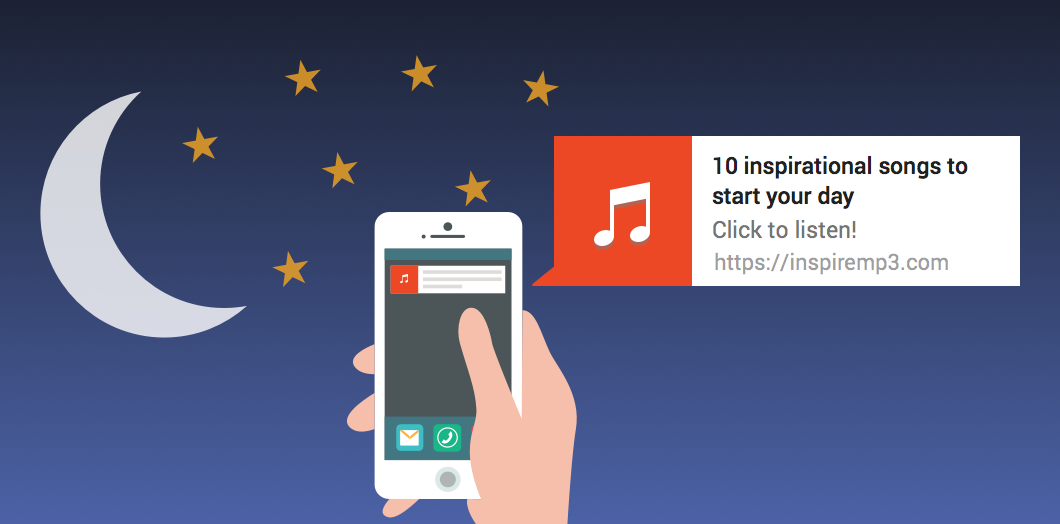
Website Push Notifications, by their very nature, require an instant response on the part of the receiver. This makes timing all the more important. A classic mistake when sending push notifications is not take into account the time zone your subscribers are located in. To fix this, you need to have a clear understanding of how your subscribers are spread around the globe and be very particular that each time zone receives the message at an appropriate time. It’s definitely more complicated than sending out a notification in a single batch, but that’s the kind of effort that is required in this highly-personalized environment. For example, you don’t want to end up this notification when the stars are twinkling, do you?
Another thing that you need to consider is that different kinds of notifications work at different times of the day. If you are sending a promotional message, you want your users to be in a restful state of mind so that they have the mental bandwidth to check out your offer. Choosing to send something funny and light-hearted? Go for the afternoon, when people are feeling bored in the office and want something to crack them up.
How Frequently to Send
Probably the most important thing to consider as you scale up your push notification campaigns is the frequency of your messages. Since push notifications is a high-engagement communication channel, you need to be really careful not to inundate your subscribers with more notifications that they can handle.
Since website push notifications is a fairly new technology, there is no data out there on optimal frequency. At this stage, you need to carefully monitor your click rates, time on page, bounce rate and opt-outs after every push notification to find out which frequency works best for your audience.
Using Segmentation to Send Personalized Notifications
As Ecommerce marketers, personalized messages are nothing new for us. We all know that they work. However, it is doubly critical to not follow the spray-and-pray approach when it comes to website push notifications, simply because opting-out is so easy and there is no way for you to get those unsubscribers back, unless they change their settings. For example, this guy is totally opting-out after receiving this notification.

Ecommerce players, therefore, need to categorize their subscribers into different buckets that are as narrowly defined as possible. One way of doing this is to ask subscribers for preferences at the time of opting-in. Another very effective way is to go for behavioral segmentation i.e. putting subscribers into different segments based on their on-page activities like type of pages viewed, number of views of a particular page etc. For example, if I’ve been checking out books in the spy thriller genre lately, the store should mark me as someone who’s interested in the genre and send me a notification whenever something new is published in that category.
What Metrics to Track
The most immediate metric that comes to mind when thinking website push notifications is click rate. This is how many people clicked on the notification as a percentage of the number of people to whom that notification was delivered.
However, just focusing on this one metric can lead your analysis astray. Instead, you should strongly focus on the business goals you deem most important, which in this case would be sales (primary goal) and visits to checkout page, add to cart (secondary goals). Tag your notification links with the proper UTM parameters and then sift through the data in Google Analytics and other analytics tools you are using to find out how many people arriving on your website via push notifications are actually performing the above actions. This is the only way that you will be able to determine whether website push notifications are working for you or not.
That’s it! This covers almost everything you need to know as you start with website push notifications for your online store. Just remember – keep listening to what your audience is trying to say and keep iterating on the basis of that!
About the Author: Anand Kansal works at PushCrew, a tool that enables websites to send push notifications on desktops, mobiles and tablets. He tweets about push notifications and online marketing in general at @PushCrewHQ.
Subscribe to:
Posts (Atom)